Hemlocks: western and mountain yamadori, flail mowed and other roadside finds

ralfish

Sapling
Messages
44
Reaction score
85
Location
BC, lowermainland
USDA Zone
8b
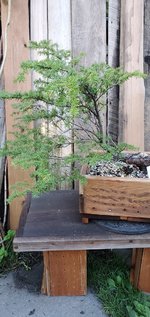
I'm not sure if there's a study group or similar dealing with western and or mountain hemlocks. My apologies if there is. But anyone on the west coast north of California thats ignoring these trees is missing out. I live in Vancouver BC so these trees are common in this area with Mountain hemlocks being in the local mountains. I'm not a big fan of collecting ancient yamadori unless its roadside and doomed to being flail mowed or otherwise doomed. So here we have a hemlock collected recently that was in a small debris slide. Most of its roots were exposed for an unknown amount of time but the elevation was high enough that snow had only recently melted in the last 2 weeks or so and we hadn't had any high temperatures yet. In fact the local wet cool weather has been ideal. It's in a transition area that grows both western and mountain hemlock, but I'm reasonably sure this one is a mountain hemlock, but I've been fooled before. I've collected in the same area before, as its prone to small debris slides in the winter and every now and then gives up some small but interesting trees that would otherwise die if not collected (they may die anyhow) I'm pretty excited about this tree in particular. Since collection its continued to bud out but from past experience they move slowly and do tend to hold energy for a long time before giving up the ghost. Its living in straight pumice in the shade where it gets a couple hours of sun a day. Other than boxing it up, I have done nothing. I collected a couple of other hemlocks in the same trip but this one is the one that is making me excited the most. The thing most of the other trees I've collected here from this particular debris slide area in the past is they all have a good deal of damage both new and old so it shows just what these trees go through when they end up growing in a bad location. Thats a win for me. My job is to keep it alive now. I'll probably clean some of the dead branches away but for the next year or two not much else. I guess I'll add pics of other trees in the comments, I'm not sure.
 

Attachments

  • 20240529_185131.jpg
    20240529_185131.jpg
    253.9 KB · Views: 104
  • 20240529_185152.jpg
    20240529_185152.jpg
    242.9 KB · Views: 94
  • 20240529_185139.jpg
    20240529_185139.jpg
    261.1 KB · Views: 90
Here's another hemlock collected from the same area on the same day. It also shows previous damage from slide activity. The roots were not exposed hence the different grow media. I made several grow boxes from old cedar fencing material someone was getting rid of, freshly stained prior to disposal. The hard bend of the trunk seems to be common in this area, and Im not sure if its from snow or slide damage or both.
 

Attachments

  • 20240529_184115.jpg
    20240529_184115.jpg
    214.2 KB · Views: 69
  • 20240529_184207.jpg
    20240529_184207.jpg
    206.9 KB · Views: 65
  • 20240529_184139.jpg
    20240529_184139.jpg
    212.5 KB · Views: 63
  • 20240529_184226.jpg
    20240529_184226.jpg
    170.3 KB · Views: 69
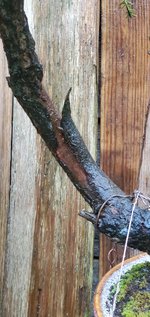
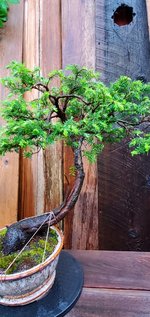
Here's a western hemlock (I think) that was also collected from the same slide area. Notice the similar trunk bend. This one I've been working on for a few years now. In the third pic you can just sort of see a branch that got depressed and died. Kind of changes the overall shape of what I had going on. But thats just another design change opportunity. The interesting thing here, is the damage that was sustained prior to collection. Nothing was really noticeable, then 2 full years after collection all of the sudden a split in the bark appears and the split kept growing. I initially thought it was just the tree growing as it was healthy and putting on lots of new growth. Instead this damage appeared. Fungi showed up too. Not really good news but the tree seems healthy other than dropping that one branch. I was amazed at just how far along the healing had already taken place once the bark lifted enough to reveal it. I repotted it this year too, which revealed old severe trunk damage that basically caused the big bend of the trunk. None of that was really visible prior to this years repot as existing mountain soil kept it hidden. I think all of the original soil is now been replaced except the very surface soil where so many of the fine feeder roots are. I generally take my time with that with these mountain origin trees. Not your typical conifer pot but its not your typical conifer either.
 

Attachments

  • 20240526_173654.jpg
    20240526_173654.jpg
    163.7 KB · Views: 75
  • 20240526_173721.jpg
    20240526_173721.jpg
    172.8 KB · Views: 51
  • 20240526_173425.jpg
    20240526_173425.jpg
    195.7 KB · Views: 53
  • 20240526_173034.jpg
    20240526_173034.jpg
    206.8 KB · Views: 54
  • 20240526_173337.jpg
    20240526_173337.jpg
    206.8 KB · Views: 73
I did a bit of work on the hemlock i recovered from minor slide debris. Just removed some of the fine dead branches to clear things up a bit. I cleaned the trunk of impacted dirt and found the trunk is split right through which you can see in the third pic. Thats some pretty intense damage this tree has previously sustained and is healing from. I started to notice though that the foliage didn't look right in the position I initially had the tree (first pic) So I started tilting things utilising the orientation of the needles to indicate roughly the position the tree had been last growing in. I'm not sure if this will end up being the ultimate position but for now this is how its going to be, at least for now during the recovery period.(Last 2 pics) Ultimately I'm concerned about the cascade position as I don't want to be fighting the nature of the tree trying to maintain that position.
 

Attachments

  • 20240529_185152.jpg
    20240529_185152.jpg
    242.8 KB · Views: 46
  • 20240609_182623.jpg
    20240609_182623.jpg
    218.6 KB · Views: 44
  • 20240609_182551.jpg
    20240609_182551.jpg
    194.2 KB · Views: 44
  • 20240611_074830.jpg
    20240611_074830.jpg
    231.3 KB · Views: 41
  • 20240611_074850.jpg
    20240611_074850.jpg
    219.1 KB · Views: 64
Nice pistol butted tree!

As you mentioned, this tree will resent being a cascade and will soon go vertical. Just like when when the slide caused the original damage. So one must choose an appropriate design…. What do you think about rotating the box 90 degrees from the cascade position (whichever way looks best, and grow the tree hard so it gives another twist? Properly managed with its inclination to grow upwards… and perhaps a bit of twisting, should result in a very interesting final design

Based our experience working with a number of Mountain Hemlocks, agree this tree is very weak and needs a couple years of growing out to build strength and become robust and healthy.

Would love to see the tree’s progress in over time.

Cheers
DSD sends
 
What do you think about rotating the box 90 degrees from the cascade position (whichever way looks best, and grow the tree hard so it gives another twist? Properly managed with its inclination to grow upwards… and perhaps a bit of twisting, should result in a very interesting final design
This is a really interesting idea, and something I’ve thought about for some time. Using the orientation of the natural growth habit to put curves in growths. It’s something I’ve heard recommended on cuttings, to stick them at a 45° angle in order to get a low bend going as they spring up. I think it would work great on such an upward growing tree—while a cascade would fit the trunkline you’ve proposed, there’s a reason you don’t see many cascade hemlocks.
 
Nice pistol butted tree!

As you mentioned, this tree will resent being a cascade and will soon go vertical. Just like when when the slide caused the original damage. So one must choose an appropriate design…. What do you think about rotating the box 90 degrees from the cascade position (whichever way looks best, and grow the tree hard so it gives another twist? Properly managed with its inclination to grow upwards… and perhaps a bit of twisting, should result in a very interesting final design

Based our experience working with a number of Mountain Hemlocks, agree this tree is very weak and needs a couple years of growing out to build strength and become robust and healthy.

Would love to see the tree’s progress in over time.

Cheers
DSD sends
The first pic where the box is horizontal is how I had the tree originally oriented when I boxed it up. I'm not sure if this is the position you are suggesting. That's not how the tree grew though as evidenced in the orientation of the foliage. The last two pics showing the box nearly vertical is how it actually grew. Right now, at least for the next while, probably until the end of this growing season depending how it does, I will probably keep it with the box in the nearly vertical position as I think its the least stressful for the tree as it won't have to direct resources to changing foliage orientation. Then maybe next season bring it back to how I had it originally (and I think what you suggest) It will take time for the foliage to adjust though. Previous experience with trees that are from harsh growing conditions and close to the limits of their natural growing areas, is they respond slowly. As the tree was found mostly bare root (for an unknown amount of time) from slide debris, I really want to take it easy on it at least for now to try to get it back to healthy vigour, hence trying to keep it in the position it grew in.
 
Back
Top Bottom