
Cruiser
Omono
Wind thrown-windblown/coastal erosion Abies procera (noble fir).
A work in progress.
Current:

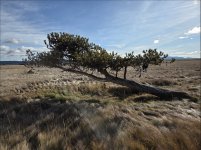
Trunk form is influenced by full size lopsided trees. Those that grew at an angle, those that were tipped, and those that were battered into form. Trees encountered in coastal areas and on rocky islands, around alpine lakes, clinging to slopes or cliffs, upon ridge tops, and growing out from beneath choking canopies.
Influencing forms and other lopsided trees.
Sitka spruce on the Olympic coast. Formerly an upright tree on a hill. An eroding foundation has altered its planting angle.
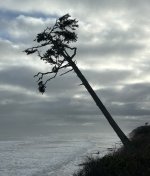
Douglas-fir. A perfect example of windblown. Either its top was broken out some time ago and/or it has reached a height at which freezing wind/salt spray kills vertical growth preventing the tree from getting taller.

The left side is leeward. It faces away from coastal wind. It gets damaged less frequently and severely. Growth is more likely to survive there, so the tree builds itself in that direction, leading to an exaggerated lateral form.
As a Douglas-fir, it keeps trying to grow vertical and on the windward side. This growth sometimes lives long enough to create appreciable structure. Inevitably, it dies and becomes deadwood, which serves to provide additional shelter for interior and leeward growth.
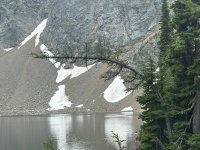
Shade-intolerant alpine larch in the North Cascades. On one side, a sunny lake. On the other side, densely stocked shade-tolerant species and tall slope.
I can’t say exactly what stimuli caused the trunk to bend this way. Probably a combination of better light conditions and bending from snow/ice. Whatever the reason, this tree is embracing the extra light it gets as a result.
Lower branches on the trunk underside have adapted. Topside growth is emerging vertical as is usual for the species.
Culturally modified Douglas-fir. Bent by native people long ago. Many trees on this island have been modified in some way.

Monterey Cypress.
Flattened, dense, oblong canopy at the end of a bare slanted trunk.

Douglas-fir. Formerly an upright tree on stable ground. Over a long period of time, the earth beneath its feet has crumbled into the sea.
The “apex” has developed into a dense flattened crown level with the cliff edge.
Remnant branches from a vertical life are retained.

Douglas-fir. Lopez Island. Previously upright, it has settled into a slanted form. Top growth has adjusted into vertical alignment, but has also slowed from age or wind or both. Lateral extension and epicormic growth continues. Lower branches bask in light reflected off the water.

Western hemlock along a crowded forest edge. Probably bent from snow and growing outwards in the direction of better sunlight. It has not developed a strong vertical leader yet.

Giant pacific madrone on a tiny island in the Salish Sea. Bounded by Douglas-firs that partly block sun from the south, this tree has grown diagonally out over the water to access more light.

Windthrown rafting western red cedar. When it fell over, the trunk landed on a rotting stump, into which it has layered. Very unusual.

Partial windthrown alpine larch. These are probably the most wind-firm tree species in Washington, yet even they are subject to blowing over.

Red Alder growing slanted away from bigleaf maples to access more sunlight. Trees in the background are covered in life-threatening amounts of english ivy.

Another Douglas-fir growing outwards over the sea. Those that reach an angle this extreme often present flattened crowns, branches growing downwards, and minimal vertical growth.

Yet another fir existing at an earlier stage of the coastal-erosion-tipping-process. In time, it will descend into a horizontal position like the others, then fall into the sea.

A work in progress.
Current:
Trunk form is influenced by full size lopsided trees. Those that grew at an angle, those that were tipped, and those that were battered into form. Trees encountered in coastal areas and on rocky islands, around alpine lakes, clinging to slopes or cliffs, upon ridge tops, and growing out from beneath choking canopies.
Influencing forms and other lopsided trees.
Sitka spruce on the Olympic coast. Formerly an upright tree on a hill. An eroding foundation has altered its planting angle.
Douglas-fir. A perfect example of windblown. Either its top was broken out some time ago and/or it has reached a height at which freezing wind/salt spray kills vertical growth preventing the tree from getting taller.
The left side is leeward. It faces away from coastal wind. It gets damaged less frequently and severely. Growth is more likely to survive there, so the tree builds itself in that direction, leading to an exaggerated lateral form.
As a Douglas-fir, it keeps trying to grow vertical and on the windward side. This growth sometimes lives long enough to create appreciable structure. Inevitably, it dies and becomes deadwood, which serves to provide additional shelter for interior and leeward growth.
Shade-intolerant alpine larch in the North Cascades. On one side, a sunny lake. On the other side, densely stocked shade-tolerant species and tall slope.
I can’t say exactly what stimuli caused the trunk to bend this way. Probably a combination of better light conditions and bending from snow/ice. Whatever the reason, this tree is embracing the extra light it gets as a result.
Lower branches on the trunk underside have adapted. Topside growth is emerging vertical as is usual for the species.
Culturally modified Douglas-fir. Bent by native people long ago. Many trees on this island have been modified in some way.
Monterey Cypress.
Flattened, dense, oblong canopy at the end of a bare slanted trunk.
Douglas-fir. Formerly an upright tree on stable ground. Over a long period of time, the earth beneath its feet has crumbled into the sea.
The “apex” has developed into a dense flattened crown level with the cliff edge.
Remnant branches from a vertical life are retained.
Douglas-fir. Lopez Island. Previously upright, it has settled into a slanted form. Top growth has adjusted into vertical alignment, but has also slowed from age or wind or both. Lateral extension and epicormic growth continues. Lower branches bask in light reflected off the water.
Western hemlock along a crowded forest edge. Probably bent from snow and growing outwards in the direction of better sunlight. It has not developed a strong vertical leader yet.
Giant pacific madrone on a tiny island in the Salish Sea. Bounded by Douglas-firs that partly block sun from the south, this tree has grown diagonally out over the water to access more light.
Windthrown rafting western red cedar. When it fell over, the trunk landed on a rotting stump, into which it has layered. Very unusual.
Partial windthrown alpine larch. These are probably the most wind-firm tree species in Washington, yet even they are subject to blowing over.
Red Alder growing slanted away from bigleaf maples to access more sunlight. Trees in the background are covered in life-threatening amounts of english ivy.
Another Douglas-fir growing outwards over the sea. Those that reach an angle this extreme often present flattened crowns, branches growing downwards, and minimal vertical growth.
Yet another fir existing at an earlier stage of the coastal-erosion-tipping-process. In time, it will descend into a horizontal position like the others, then fall into the sea.
Last edited: