Air-layering timing?

Air-layering can be done when:

  • Best as early as possible, winter could work.

    Votes: 5 21.7%
  • Seven days after the spring tide, when the sun and moon are at right angles.

    Votes: 4 17.4%
  • Between early spring and mid summer.

    Votes: 13 56.5%
  • Totally depended on the plant.

    Votes: 6 26.1%
  • Non of the above, check my post.

    Votes: 1 4.3%

  • Total voters
    23
"Double air-layer is not problem if done on different trunks / branches". (Back to me) Be certain "if" (did you notice "if"???) but "if" you tried a double air layer on a plant, I tend to think you would want to make absolutely certain they were not double stacked on the same branch/same trunk, because you would probably get one success and one failure, (or both failures?).

I've done double and even triple layers on the same trunk. I've had it work on olives, on maples and on pomegranates. It failed on liquidambar, but I think that was unrelated to the double-stacking. I'll try again this year. I'm going to do the same on some fruit trees as well.
 
done double and even triple layers on same trunk. the double-stacking.
@michaelj I'm asking for clarification so I can understand clearly/specifically what is being said here. I understand the possibilty of multiple air layers in the separate branches of a same trunked plant (each cut site having enough leafing above it to supply the necessary auxin), as opposed to stacking air layers on a single branch or stacked on a single trunk. What you seem to be saying is you've successfully stacked two and three air layers on a single branch or single trunk. If you are indeed saying you successfully stack air layers, what is the "minimum" or "the" distance between air layers you do and what is the nature of the branching/leafing above or feeding each air layer? Am I making my question clear?
 
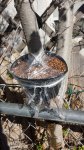
Yes. When I say stacking, I mean like in the attached photo with three pots. Not the attached photo with two pots.

As far as I can recall, I have never stacked a branch, but I would consider doing so on a strong enough branch. However, yes, I have also successfully stacked two and even three air layers on the same trunk of the mother tree. As you can see in the one photo, I didn't leave very much space between them. Probably well less than a half-foot between the cuts. What I considered important was making sure that between each air layer there were branches that had healthy foliage. All three rooted very quickly. If they hadn't, it would have been no big deal to me, because I was doing the layers in lieu of just a trunk chop, but they took.

Last year I did at least four double-layers on single trunks of Japanese maples (two trees, two rounds, two stacked airlayers each time, so in total I pulled 8 new trees off the two main trees), where the trunk was 1.5" thick or so, and on those, the layers were a little farther apart simply because of how the branching was arranged.

I did a double stack on a Chinese elm last year, both on the same trunk at the same time. About 2" thick. The layers on the olive were also a little farther apart for the same reason.

My sample size isn't very large. Over the last 2-3 years I've stacked probably less than 30 times, and on just five or six species. But every single one of them took, except for the ones where I used a wrapped moss technique instead of a potted soil technique. Perhaps they'd have done better if I'd done them one at a time, but I didn't feel like spending two or three years to take them all, especially on the maples, where I started with a couple of 14-15 foot tall trees that I'm airlayering off new trees until I get down to 18".

If I had a tree where the top was my next perfect shohin, and I wanted to play it safe, I'd probably do just the one airlayer at a time. But absent that, given my past experience, I wouldn't hesitate to stack, at least not those easy-to-layer species I've stacked successfully before.
 

Attachments

  • triple.jpg
    triple.jpg
    170.1 KB · Views: 59
  • nonstack.jpg
    nonstack.jpg
    315.2 KB · Views: 57
Yes. When I say stacking, I mean like in the attached photo with three pots. What I considered important was making sure that between each air layer there were branches that had healthy foliage. All three rooted very quickly. If they hadn't, it would have been no big deal to me, because I was doing the layers in lieu of just a trunk chop, but they took.
Thanks, nice, got it. Even though there doesn't appear to be much branches between each pot, that must have been enough. Good job and congratulations, if I could I'd enter your name in the drawing for this months "B-Nut Best Air-Layering Accomplishments" or "B-Nuts Spring 2016 Best..."
But every single one of them took, except for the ones where I used a wrapped moss technique instead of a potted soil technique.
Which brings up another request for specific detail, (hope your typing skills are much faster than mine, I do appreciate your willingness to respond). Just did a couple air layers on vine maple, and took what I considered the easy way out of pealing an existing moss blanket from a nearby maple trunk and wrapped it on my barkless areas, then plastic wrapped, rather than do the other cosideration - the plant pot and soil, (I probably would have gone with about 60% pumice and 4o% potting soil, then plastic wrap to keep in moisture). So am I understanding you, potted soil has worked better for you (in what I would assume is a warmer dryer climate? Is there moss generally growing on anything in the surrounding county?)? If soil, rather than moss, would you also be so kind as to divulge the soil/mix? Annnd, please address the issue of no plastic wrap vs wrap to keep in moisture. Annnd, I see in your righthand photo (your doublet) what looks like top moss, is it just a topping or??? Sorry, am I asking too many questions? Last one, I promise, unless your response elcits more. How long before you removed them from the mother?
 
As for timing.. MOre and more I start to come to a conclusion.. It is a 2 fase thing: First, the cutwound starts to callus over. From the callus, roots emerge. So you want to have the callus ready, when foliage begins to unfold: By the time the leaves start to emerge, the whole plant is in a 'recovery from winter' modus. This includes creating new roots (Which is why repotting in spring is so easy: Hardly any foliage, and explonding root development). This might be a reason for putting a layer in just as the buds are waking up.

I am tempted to aim for earlier layering then typically recommended. I have a few to set this year, and will do so when the buds start to pop on the plants.
I'm doing the same thing to ulmus pumila this year, they are almost finished flowering so I'll be setting my layers within a few days I think.

Aaron
 
So am I understanding you, potted soil has worked better for you (in what I would assume is a warmer dryer climate? Is there moss generally growing on anything in the surrounding county?)? If soil, rather than moss, would you also be so kind as to divulge the soil/mix? Annnd, please address the issue of no plastic wrap vs wrap to keep in moisture. Annnd, I see in your righthand photo (your doublet) what looks like top moss, is it just a topping or??? Sorry, am I asking too many questions? Last one, I promise, unless your response elcits more. How long before you removed them from the mother?
I'm in Southern California, which has a Mediterranean climate. It's fairly dry, but we get winter and spring rains, so we do have moss growing on shady spots during the winter and spring near here. I'm not really sure why the wrapping method hasn't worked for me, but I'm guessing that it's because I let them alternate between being too wet and too dry.

With the potting method, I use three layers - a thin later of sphagnum moss to act as a screen at the bottom (because the hole for the trunk is never precise), then a layer of bonsai soil or pure DE (Napa oil-dry) up to about an inch above the top of my cut, then a thin layer of sphagnum moss to help keep it from drying out. I use a few different mixes for my usual bonsai soil, but for air layering, it's usually small lava or pumice, plus DE, and about 10% potting soil and 10% fine bark. Then I water the pot every day like the rest of my trees. Between the daily watering, the 20% organic component in the soil, and the top layer of moss, it stays plenty moist around the cut, but because the soil drains really well, it doesn't sit in water and once the roots start to push, it's already in good soil. So sometimes when I remove the tape and pull the edges of the plastic pot away, the soil holds together and I'm just slip-potting it after I've separated it from the mother tree.

How long is a question I can't really answer. I leave it on until it's built a decent root ball. In some cases (like with my junipers) that can be a long time. One was on for more than a year. For bougainvilleas, elms and pomegranates, it can be just a few weeks. If I'm particularly enamored of the top, I'll be more conservative and keep it on until the pot is swelling with roots. If I can sort of take it or leave it, I might separate it as soon as it has more than three or four roots visible along the edge of the pot when I pull back the tape to take a look.
 
Just set my first layer of the season, my elm is done blooming and is setting seeds now. It's not a huge trunk probably only around 2in, but it's difficult to layer in my climate. I used NAPA #8822 DE.

Aaron20160302_095242.jpg 20160302_095249.jpg
 
Back
Top Bottom