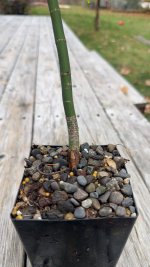
Rough bark Japanese maple grown from seed

Oro

Seedling
Messages
10
Reaction score
21
3 seasons ago, I collected seeds from a rough bark Japanese maples. About 30 of them sprouted. 3 years later, 2 of them seem like they inherited the rough bark characteristics and a few others show some signs.

Does anyone have experience with growing Japanese maples seeds from popular cultivars? What are the chances that they inherit the desired characteristics? I’m hoping these inherit the rough bark but with smaller leaves.
 

Attachments

  • IMG_9609.jpeg
    IMG_9609.jpeg
    496.6 KB · Views: 66
  • IMG_9613.jpeg
    IMG_9613.jpeg
    486.3 KB · Views: 64
  • IMG_9612.jpeg
    IMG_9612.jpeg
    372 KB · Views: 69
  • IMG_9614.jpeg
    IMG_9614.jpeg
    213.4 KB · Views: 71
  • IMG_9606.jpeg
    IMG_9606.jpeg
    246.5 KB · Views: 71
  • IMG_9608.jpeg
    IMG_9608.jpeg
    443.3 KB · Views: 64
  • IMG_9615.jpeg
    IMG_9615.jpeg
    250.8 KB · Views: 57
  • IMG_9610.jpeg
    IMG_9610.jpeg
    266.8 KB · Views: 70
I grow a lot of JM from seed. Likelihood of seedlings having similar characteristics of the parent depends on the cultivar and the characteristics. 'Senkaki' usually gives more than half the seedlings with red bark and another 25% with varying shades of red bark. 'Seryu' has given less than 1% seedlings with the deeply divided leaves. Weeping dissected leaf cultivars produce almost all dissected leaf seedlings. Most red leaf cultivars give mostly red leaf seedlings. Dwarf cultivars give mostly dwarf seedlings. Weeping cultivars seem to give a high proportion of weeping seedlings though few seem to survive long term.
I have not grown enough rough bark JM to give any estimate on rough bark heritability

Need to be aware that all seedlings will have some differences from the parent due to the lottery of gene combinations that comes with sexual propagation. Even if the most obvious characteristic appears similar there will almost certainly be other differences - eg ultimate size, pest and/or disease hardiness, drought tolerance, etc, etc.
Not trying to discourage people from growing seed. I find it both rewarding and interesting as the seedlings develop whatever characteristics they have inherited. Just understand that growing seed is a lottery so every seedling is a new and unique individual.
 
  • Like
Reactions: Oro
I grow a lot of JM from seed. Likelihood of seedlings having similar characteristics of the parent depends on the cultivar and the characteristics. 'Senkaki' usually gives more than half the seedlings with red bark and another 25% with varying shades of red bark. 'Seryu' has given less than 1% seedlings with the deeply divided leaves. Weeping dissected leaf cultivars produce almost all dissected leaf seedlings. Most red leaf cultivars give mostly red leaf seedlings. Dwarf cultivars give mostly dwarf seedlings. Weeping cultivars seem to give a high proportion of weeping seedlings though few seem to survive long term.
I have not grown enough rough bark JM to give any estimate on rough bark heritability

Need to be aware that all seedlings will have some differences from the parent due to the lottery of gene combinations that comes with sexual propagation. Even if the most obvious characteristic appears similar there will almost certainly be other differences - eg ultimate size, pest and/or disease hardiness, drought tolerance, etc, etc.
Not trying to discourage people from growing seed. I find it both rewarding and interesting as the seedlings develop whatever characteristics they have inherited. Just understand that growing seed is a lottery so every seedling is a new and unique individual.


So you’re telling me there’s a chance I can win the lottery? What are the chances that a seedling can have rough bark and small red leaves with tight internode?
 
Does anyone have experience with growing Japanese maples seeds from popular cultivars?

Contrary to popular belief in North America and Europe, in Japan it is common practice to grow certain cultivars from seed. However, it's important to clearly label them as such, because a seed will 'never' retain 100% of the genetics of the parent plant material. This is especially common for Arakawa in particular, but I have seen it done for Deshojo as well. Technically, it would suffice to refer the cultivar as 'arakawa' (using single quotation marks) and to the seedlings with rough bark as arakawa (the adjective and noun, meaning rough skin i.e. bark). But that system is prone to error, so it's much better to simply refer to the seedlings in long form as 'seedlings from an awaraka'.

As a general rule, it's good practice and strongly recommended that we use cutting, grafting, and air layers to 'preserve' cultivars*. Yet, as important as that idea is, it's often overstated. We tend to overlook the fact that epigenetic factors (notably, but not exclusively, environment) can alter gene expression and therefore phenotype (i.e. observed differences) without altering the underlying DNA sequence. I mention this because I have seen seedlings of deshojo, arakawa, and beni chidori that appear in a given plant at a given moment more like the cultivar and parent than a cutting from that parent plant might.

*I would add that there can be significant phenotypic difference when a cultivar is on its own roots vs grafted (and, by and large, the nursery industry around the globe has named cultivars based on grafted specimen).

So you’re telling me there’s a chance I can win the lottery? What are the chances that a seedling can have rough bark and small red leaves with tight internode?

I personally grow 'Yves Arakawa', which was grown from a seed and develops rough bark like 'Arakawa' with other advantages (like vigour and apex strength). Mr. Valavanis has also been collecting seed from his 'Arakawa' for many years - he has written about it on his blog and here too I believe. In other words, there is precedent that your seedlings will could develop nice consistent bark. As for leaf shape/size/color, it's hard to say. Sergio (M5Bonsai) gets incredible spring color on his 'Arakawa' and from memory that seems to be a consistent trait, which I have not seen any other 'Arakawa' or arakawa get quite like it

 
Last edited:
So you’re telling me there’s a chance I can win the lottery? What are the chances that a seedling can have rough bark and small red leaves with tight internode?
There's always a chance to win the lottery. That's why so many people buy tickets. Same applies to growing JM seed aiming for a specific result.
The more combinations you are trying to combine, the lower your chances become but wins are still possible. In theory, an infinite number of monkeys on an infinite number of typewriters should produce the complete works of Shakespeare.
The more seeds you sow the better your odds of getting what you are after. The limiting factor is usually how much space and time you have to grow them all out until the required characteristics become apparent.
 
  • Like
Reactions: Oro
So you’re telling me there’s a chance I can win the lottery? What are the chances that a seedling can have rough bark and small red leaves with tight internode?
This depends on genetics and age. Tight internodes are a characteristic of most seedlings. It can lengthen as the tree grows and it isn’t pruned back. “yatsubusa” in a cultivars title means tighter internodes
 
  • Like
Reactions: Oro
There's always a chance to win the lottery. That's why so many people buy tickets. Same applies to growing JM seed aiming for a specific result.
The more combinations you are trying to combine, the lower your chances become but wins are still possible. In theory, an infinite number of monkeys on an infinite number of typewriters should produce the complete works of Shakespeare.
The more seeds you sow the better your odds of getting what you are after. The limiting factor is usually how much space and time you have to grow them all out until the required characteristics become apparent.

I like those odds. If I can get even half of the characteristics i’m looking for, I’ll consider that a win
 
I like those odds. If I can get even half of the characteristics i’m looking for, I’ll consider that a win
Julian Adams is also working with " Arakawa "
Check out his website Adams Bonsai ( www.adamsbonsai.com ) he is located in Lynchburg Virginia. Also a good source for information on JWP and the Zuisho cultivar.
 
Back
Top Bottom