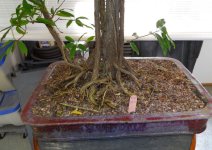
Following are Leo's main posts from the two other threads. I will try to copy and paste his photos in a separate post. Warning, long text!
"Rare is relative. This is a Ficus species, brought into the USA by an orchid collector sometime in the late 1980's. He thought it a waste of space in his greenhouse and gave it to me around 1994. It was collected in the hills around San Cristobal, state of Chiapas, Mexico. I assume Ficus species are not rare in habitat. However, I have not found a match in any botanical description of any neotropical Ficus species. As a result I have distributed cuttings labelled as Ficus from Chiapas. To my frustration Jerry Mieslick started calling it 'Mexicali' which obscures its origin. His specimen of 'Mexicali' came from me, a decade ago or more, we regularly discussed finding a name or a taxonomist to describe it.
"It resembles the "nomen nudem" sold in the hobby as a willow leaf Ficus with several significant differences. It has this shredding reddish bark that the willow leaf Ficus does not have. The leaves on the average are wider than willow leaf, though not longer. It forms aerial roots easily even in somewhat lower humidity and lower temperatures. It is also deciduous, in that regardless of watering, it tends to be leafless January, February and part of March. It can tolerate total drought during this period. Alas, another difference, nobody I know has been able to get it to produce synconia (fruit). the willow leaf Ficus sold by Wigert's and other Florida vendors does produce fruit regularly when given sun and allowed to grow.
"The fruit issue might just be due to my northern climate, but Jerry Meislick could not get fruit either. We need fruit to give a taxonomist the key traits needed for either identifying it to species or writing a species description if indeed it is new to science as I suspect it is.
"Ficus from Chiapas makes cuttings easily, I plan to do a batch this summer. It might be a common but unappreciated "weed" in Chiapas, but to the best of my knowledge, all individuals of this species in USA trace back to this plant.
"If I have a successful batch of cuttings, I will be selling them, at a modest price. The caveat is I want all recipients to agree to be careful with correct naming. I want no "new names" made up for this species unless it is a formal botanical description published in a botanical journal. No new names like 'Mexicali', it needs to remain 'Ficus species from San Cristobal, Chiapas, Mexico', or 'Chiapas' for short. We must make an effort to preserve provenance until it is understood what this specimen represents.
"Right now it is getting ready to go dormant, I won't try to root cuttings now. We will see what success I have in spring. I will post on BNut first when I have a batch of cuttings rooted and ready to send out. They will be cuttings, hence small, but they are rare material, and this thing grows FAST when sun, heat and humidity happen at the same time.
"It doesn't need super high humidity, but anything over 40% visibly improves growth and aerial root development.
"Pros and Cons of Ficus species from San Cristobel, Chiapas, Mexico, or 'Chiapas' for short.
"Pros
Likes summer outdoors in Chicago area, which means not excessively hot. I live less than 3 miles from Lake Michigan, and frequently get Lake Effect" cooling from the Lake all summer. I finally installed air conditioning only 3 years ago. Did not need it until recently. Point being, summers rarely have daytime highs above 85 F, and the Ficus seems happy with it.
"Tolerates cold down to upper 30's. Light frosts were tolerated without total leaf drop, but clearly there was some damage to growing tips due to frost. Growth seems to slow or stop below 60 F.
"Any time I put it outdoors for the summer, new aerial roots form. Local humidity varies from 40% to 90% with most common being 60 to 80% outdoors. Not desert dry, not Florida or Louisiana humid. Indoors, I like to keep paint on the walls, so indoor humidity is usually quite low. No aerial roots form when indoors, but roots formed over summer usually persist.
"Shredding reddish brown bark is really nice.
"Cons:
Branches want to be dead arrow straight. They have a poor memory, like a politician, it takes several years of wiring and re-wiring to get a curve to set. But once a curve has set, enough wood has formed, the curve will stay. Forcing a branch to go below horizontal is difficult.
"Branches wire scar easily and marks remain for years.
"This is a deciduous but tropical Ficus. It tends to loose 100% of its foliage January, February and part of March. Then a flush of new growth starts and its like having a deciduous tree explode with growth. While leafless it is not necessary to water the tree at all. One year I put it on my attic stairs, cool and dark end of December to get it out of the way, I did not remember it was there until May, I watered the leafless tree and it burst into growth all over. Took a little damage, lost some fine twigs, but for being forgotten, I was quite happy it survived. So ''in season:" it is very drought tolerant.
"I would say its biggest draw back is its tendency to dead arrow straight branches, and strongly resisting any bending that takes a branch below horizontal. Everything wants to reach up. If you keep these traits in mind, most styles are appropriate, especially 'banyan style' and most upright styles. Cascade is a poor choice for this species. Individual, group and forest plantings are appropriate for this species. Due to its aggressive surface roots, mixed species planting may or may not work. Ferns might work."