Hundreds of California Junipers

DDOZ

Sapling
Messages
25
Reaction score
32
Location
Palm Springs, California
USDA Zone
10A
So - I did a bonsai scouting run today up in high desert in California to a spot that is supposed to have both Pinion Pines and California Junipers. It's up at about 3500 ft elevation.

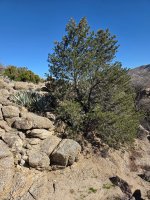
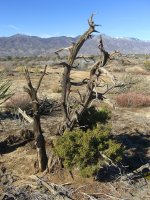
Sigh!!! There were some pines there but they are all about 10 - 15' tall so much too large to dig. The junipers are EVERYWHERE up there. Only problem is that they are all about as big as a volkswagen and probably 100 or more years old (may be 200 years old) - way to big to get out. I did find two that are about 3' tall, but coming out of cracks between big granite boulders so would be a challenge to get out. There are other high desert plants up there as well including scrub oaks which are small enough to dig.

Before you all want to know where this place is (and I'm not telling anyone just yet) - I have to visit my local BLM office and find out what the regulations might be for collecting plants from this area. As far as I can tell, it's US Forest Service land that the local BLM office manages. For interested people in SoCal - I'll keep you posted.

Question - If it is OK to dig plants there and if I can get one of the Junipers out, it most likely would end up with no soil remaining on the roots. I've heard that sometimes the mountain junipers have one big tap root but not much else. What do you think the chances are that it would survive the digging and replanting?

Here are a couple of photos.
 

Attachments

  • 20260111_114916.5.jpg
    20260111_114916.5.jpg
    516.9 KB · Views: 109
  • 20260111_115027.4.jpg
    20260111_115027.4.jpg
    419.8 KB · Views: 109
Question - If it is OK to dig plants there and if I can get one of the Junipers out, it most likely would end up with no soil remaining on the roots. I've heard that sometimes the mountain junipers have one big tap root but not much else. What do you think the chances are that it would survive the digging and replanting?

Slim to none
 
No soil on the roots is OK when I transplant J. chinensis and J. procumbens. I prefer to remove as much field soil when transplanting any trees as field soil is often a problem in pots.

One big tap root and not much else is different. Larger and older Junipers seem to need a reasonable amount of feeder roots to survive.

There are so many natural plants that should be enjoyed in-situ instead of trying to 'own' them. Go visit. Study form and growth patterns. Enjoy the splendour of nature. Take the trees home in your mind and on film. Maybe recreate some of what you've seen from younger stock.
 
Before you go in there (assuming you get permission)) and start ripping out trees willy nilly, I'd find someone who knows what they're doing. Collecting trees like this is not just "get a shovel, dig, chop a root or two" and carry out a 1,000 year old trees. (Yes, those trees are WELL over 200 years old). These will require someone with experience to get successfully. You've found a place that might yield some spectacular bonsai. Now take the time and effort to insure you can do right by them.
 
(1) The big trees outside Palm Springs are in the lower elevations. You need to go higher. As you approach the treeline the trees will get smaller as conditions get more challenging. 3,500 feet sounds high until you realize Mt. San Jacinto is 10,834 feet (the mountain looming directly over Palm Springs). San Gorgonio is 11,500 feet. The same for the trees out in the Mojave. The big trees are going to be in the sheltered areas. Go to the fringes where you stop seeing as many trees.
(2) Absolutely get permission from whomever manages the forest or owns the land. Because there are so many junipers out there, it is typically not hard to get. In fact, there were even some landowners in the San Gabes who were advertising on Craigslist and giving trees away if you were willing to come remove them. They don't like all the deadwood and consider them a menace for livestock and ATV's. Also check where they are clearing land for development. If you see a bulldozer that is generally a sign that they'll let you take some trees :)

palm-springs.jpg
:)
 
Last edited:
These are not "starter" trees. Assuming you get permits to collect, you would do best to go with someone who has significant experience in collecting in these types of environemtns to maximize your chance of success. Otherwise, you are doing these very old trees a disservice.

I would personally recommend that you find an easier place to collect with trees that are not old growth to practice on.
 
If there is no soil left around the roots after digging them up, it's a bad collecting site.

There are patches of sandy dunes everywhere in my country, with the best pines one can wish for. And they're free, since they're hacked down regularly. But it's sand.. There is no way to extract a pine safely from those dunes without an excavator and roots as deep as I am tall. So I stopped looking at them as collectible and started looking at them as eye candy.
It is one of the most difficult tricks of bonsai: knowing when it's impossible.
 
Also fwiw take advice from people who haven’t collected Cali juniper from the wild with a grain of salt. Not the same as garden juniper or Chinese juniper. It’s from a specific desert ecosystem and has adapted to those conditions. Which is why you need someone experienced in the getting them out. The tree on the rock BTW probably aint collectible
 
Back
Top Bottom