journal of a Pacific Bonsai Museum intern

pandacular

Masterpiece
Messages
2,517
Reaction score
5,644
Location
Seattle, WA
USDA Zone
9a
Hi all, I'm Will, and for the summer, I will be working at the Pacific Bonsai Museum as a bonsai intern. Inspired by @DogwoodApprentice 's thread, I will be journaling my time--and hopefully repurposing these posts for my blog. As I need to attend to some duties in my own garden today, I'll start off with some background and how I got this transformational opportunity.

Those who know me have seen how quickly I've committed myself to this funny art. What started out as a hobby became a passion, then obsession, then dream of a vocation. I'm young, and highly optimistic about bonsai and community (if little else). For the last half decade, I've been working in an engineering field for which I have professional training, but as more and more of my idle thoughts have found themselves lingering on trees and art, I have struggled to put myself into that work. I'm not someone who finds it easy to half ass something--good enough isn't--and my inability to do better than "good enough" in my day job(1) was painful. A few months ago, I started applying for other jobs in my professional career with the goal of finding a role that would give me more time to focus on bonsai. While working on my resume, I got an email from PBM curator Aarin Packard, sharing an opportunity of an internship. If ever there was a fateful timing, it was here, as I had already picked out a date to quit my day job.

Stepping back even further; the first time I set a concrete bonsai career goal. I saw a post right here from @rockm that the museum was looking for a job. A job seeking part time work, with full health insurance benefits(2)! I resolved that next time such a job was available, that I would be prepared to take it. I didn't know exactly what that looked like at the time, but setting that goal allowed me to set a series of goals that became imaginable, achievable. Such as volunteering at the museum, and in the collections of others. This aim led me also to write down some mantras. I will close this journal entry with the first of these

The goal is to work on great trees, not to have them

next time, I'll write about my first couple days on the job, and maybe a bit of my last couple days on the old one

(1) I started using this term as a joke when I found answering "what do you do?", etc with bonsai rather than my corporate occupation
(2) Context for those who live in a modern welfare society, the United States has largely non-functional public health systems. One's access to quality medical care is wholly dependent on their ability to work a job or be independently wealthy.
 
Hi all, I'm Will, and for the summer, I will be working at the Pacific Bonsai Museum as a bonsai intern. Inspired by @DogwoodApprentice 's thread, I will be journaling my time--and hopefully repurposing these posts for my blog. As I need to attend to some duties in my own garden today, I'll start off with some background and how I got this transformational opportunity.

Those who know me have seen how quickly I've committed myself to this funny art. What started out as a hobby became a passion, then obsession, then dream of a vocation. I'm young, and highly optimistic about bonsai and community (if little else). For the last half decade, I've been working in an engineering field for which I have professional training, but as more and more of my idle thoughts have found themselves lingering on trees and art, I have struggled to put myself into that work. I'm not someone who finds it easy to half ass something--good enough isn't--and my inability to do better than "good enough" in my day job(1) was painful. A few months ago, I started applying for other jobs in my professional career with the goal of finding a role that would give me more time to focus on bonsai. While working on my resume, I got an email from PBM curator Aarin Packard, sharing an opportunity of an internship. If ever there was a fateful timing, it was here, as I had already picked out a date to quit my day job.

Stepping back even further; the first time I set a concrete bonsai career goal. I saw a post right here from @rockm that the museum was looking for a job. A job seeking part time work, with full health insurance benefits(2)! I resolved that next time such a job was available, that I would be prepared to take it. I didn't know exactly what that looked like at the time, but setting that goal allowed me to set a series of goals that became imaginable, achievable. Such as volunteering at the museum, and in the collections of others. This aim led me also to write down some mantras. I will close this journal entry with the first of these


next time, I'll write about my first couple days on the job, and maybe a bit of my last couple days on the old one

(1) I started using this term as a joke when I found answering "what do you do?", etc with bonsai rather than my corporate occupation
(2) Context for those who live in a modern welfare society, the United States has largely non-functional public health systems. One's access to quality medical care is wholly dependent on their ability to work a job or be independently wealthy.
This is great Will. Major Kudos and congrats for the leap!
 
Congrats and good luck. Aaron is a good dude and that museum is a pretty amazing place with some iconic trees.
 
On my first day, I arrived a bit before the others. I think it was the first time I’ve been on the museum grounds all alone. I always appreciate getting to see the space in different lights, as there’s usually something that stands out. While waiting for the curator to arrive, I shadowed the other garden while watering. Whenever I’m watching someone water, I always try to make a judgement on whether each tree should be watered—it helps me stay sharp on good watering, which is well valued at the museum.

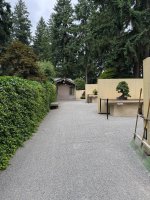
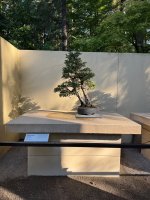
My first task was one I was looking forward to—raking the gravel. The museum grounds are largely fine gravel, and every morning it is raked into lines. It’s a nice to way to start the day, and has very pleasing results. I certainly needed something to help me wake up, as I’m not a morning person and didn’t sleep well the night before! After this, I turned all the trees on display. We rotate our trees weekly, which is no small task given the size of the trees and collection.

Like I quizzed myself on the watering, I was also looking at the trees while rotating them to make guesses as to which were in need of work. There were two in particular I noticed, and I ended up being correct, as those two were brought off display to work on. Two volunteers worked on the larch forest planting, and I was tasked with working on the Formosan juniper. The scope of work was described as a cutback, something like a haircut to make space.
IMG_6108.jpeg
In this process, I worked alongside the staff, and got quite a good deal of instruction. It was really not very different than working in my teachers’ gardens, which I enjoyed. Oh, I also made a rookie mistake and forgot my tools! Fortunately, the loaner scissors were sharp enough after a bit of CreanMate. We worked on this tree on and off for two days.

The next morning had a similar routine of opening up the display. Raking and cleaning. After we opened up, we spent much of the day fertilizing. I was tasked with pre-soaking all the trees, and then we applied a soil drench to all the trees. the fertilizer regime at the museum is rather in depth, tailored to each tree—if you’re familiar with how Bonsai Mirai fertilizes, it’s pretty similar.

One of the things that is really special about the Pacific Bonsai Museum is that we are encouraged to interact with visitors. While fertilizing, there were a great deal of questions. Rather than saying “sorry, busy”, we generally take the time to answer questions and chat with guests.
 
Last edited:
Awesome, this is a fun read. I saw someone working there the other day on a tree, I wondered to myself if they posted here.. thought about asking, but left them to their task. Being in the space alone must have been an experience.
 
I have not had as much time to stay up to date on this thread. I’ve been posting quite a bit more on Instagram. I’d like to dedicate some time to writing about the work, so in the meantime, here’s some photos.

I’m particularly pleased with the gravel. The transient nature of it as a material for a walkway canvas is fun.
 

Attachments

  • IMG_6262.jpeg
    IMG_6262.jpeg
    642.4 KB · Views: 121
  • IMG_6260.jpeg
    IMG_6260.jpeg
    902.4 KB · Views: 83
  • IMG_6261.jpeg
    IMG_6261.jpeg
    1.1 MB · Views: 77
  • IMG_6379.jpeg
    IMG_6379.jpeg
    359.3 KB · Views: 76
  • IMG_6307.jpeg
    IMG_6307.jpeg
    494.7 KB · Views: 74
  • IMG_6306.jpeg
    IMG_6306.jpeg
    762.8 KB · Views: 93
  • IMG_0187.jpeg
    IMG_0187.jpeg
    634.3 KB · Views: 110
I’m quite pleased with my work on this pyracantha that has not been on display in sometime. This tree lost a significant branch on the left, so refilling that space was the focus.
IMG_6700.jpeg
There were a few pieces of wire on when I took the befores, so the work is especially evident on the upper right rather than the apex.

The boss man gave me a few much needed pointers on applying wire to a brittle tree like this, particularly on where to place wire along the existing curves. Wiring a branch that has been wired for decades requires planning that I hadn’t seen when working on my lil juniper and maple toys a year ago!
 

Attachments

  • IMG_6664.jpeg
    IMG_6664.jpeg
    327.9 KB · Views: 60
  • 38C40252-456F-4247-BE16-5F9A7946A67F.jpeg
    38C40252-456F-4247-BE16-5F9A7946A67F.jpeg
    315 KB · Views: 56
  • IMG_6670.jpeg
    IMG_6670.jpeg
    353.5 KB · Views: 81
Thank you for sharing your experiences... and congratulations on getting to the place where you can fulfill your dreams! I'll keep reading your thread... very well done.

... and gravel looks awesome! 😍
 
Wow, it’s been over a month since I updated this thread. I’ve been keeping busy, but not enough for an excuse. The truth is that I’ve found myself burnt out from the internet and technology, and it’s made it hard to motivate to write, archive photos and notes, and even to keep in touch with far away friends. Ah well, post-modern internet solipsism is for another day.

My internship is winding down, but I don’t intend to stop coming in on volunteer days until I get back to working full-time in my other career. The routine might change a little as I switch to volunteer staff, but I’m expecting that the work won’t too much. I’ll need to talk to the boss about it some, so far we’ve been fairly casual with it—in fact, I’m not sure either of us are sure when the official last week is. All this to say was that I hadn’t spent much time reflecting on the internship until now.

Today was one of those days where it takes heroic effort to get out of bed. I had an amazing time at National’s*, but the travel whirlwind left me exhausted and I think a bit sick. I had to cancel some job interviews on Monday, bombed one (I think?) on Tuesday, and cleaned up alright with a passing interview with a different company on Wednesday. Coupled with some bad news and a bad night of sleep, I was damn near ready to call in sick and go back to bed. The absurdity of that was pretty interesting to me—I couldn’t imagine having a more excited job and I was still grumpy and rundown in the morning.

We were a little short staffed today with a few gardeners off at the dojo, and a large number of volunteers. My coworker had his hands full, so I offered to keep myself busy doing what needed doin. In retrospect, I’m pleasantly surprised with how fast I’ve gained the confidence to do this sort of thing. Sure, it was just stuff like cutting fly aways and epicormic shoots, removing old wire, and working on the landscape plants, but it’s great to feel good enough to work independently on such high quality trees. Thinking back, it’s also something that the curator has worked me up to. In the last few weeks, I had been getting much more broad instructions, such as prune and unwire all the trees in the conservatory, or check wire on all the native junipers. And I feel it paying off in my ability to trust my gut. I even pulled a long forgotten bit of wire out of a Naka tree that could’ve killed a branch down the line.

I spent the better part of the afternoon unwiring a few junipers. Unwiring someone else’s work is a good way to learn if you’re paying attention, and people with old trees also can use a hand. I recommend offering to unwire trees if you want to learn from someone.

It truly is fantastic to be able to do work that not only lifts you out of that sort of mood, but also gives you energy to do more. I came home and got a few more turns of wire on one of my own trees. Trying—and failing—to replicate a trick I learned from Captain Hook.

* If you met me at Nationals, say hi! Send me a message on here or on Instagram. I’ll probably post about Nationals later
 

Attachments

  • IMG_6998.jpeg
    IMG_6998.jpeg
    487.6 KB · Views: 54
  • IMG_7001.jpeg
    IMG_7001.jpeg
    484.1 KB · Views: 46
  • IMG_7003.jpeg
    IMG_7003.jpeg
    564.6 KB · Views: 43
  • IMG_7011.jpeg
    IMG_7011.jpeg
    513.4 KB · Views: 46
  • IMG_7013.jpeg
    IMG_7013.jpeg
    331.3 KB · Views: 51
Back
Top Bottom