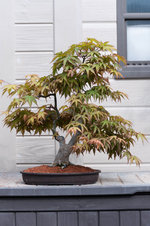
Maple pruning question

mds_1978

Yamadori
Messages
56
Reaction score
336
Location
London, UK
USDA Zone
9
Morning everyone,

My first post on BonsaiNut, and I'm very much looking forward to learning and increasing my knowledge.

I've been following an article in Bonsai Today 66 titled 'Step By Step - basic techniques illustrated' about developing ramification in deciduous trees.

I've been applying the techniques to one of my Japanese maples, but not getting the results I was expecting.

IMG_20210626_090917.jpg

After the first flush I defoliated the top part of the tree to try and get the lower branches to elongate and thicken. The lower branches haven't put out any new growth since then, which is concerning.

Also I was expecting new shoots to emerge at the bases of the petioles of the removed leaves, but as you can see I have zero growth on some branches -

IMG_20210626_090605.jpg

And on branches I let elongate and then pruned back I have new growth emerging much further back than I was expecting, rather than where the leaves were removed -

View attachment 382828

Overall the tree doesn't seem to be responding as strongly as I was expecting.

I wondering if I'm overworking the tree or using the wrong techniques for the stage it is at.

Any advice would be appreciated,

Marc.
 
The last image seems to have been eaten, so here it is -

IMG_20210626_090657.jpg
 
Hi Marc, it would be of incredible value to share your location, as people here on the forum can provide you with advices based particularly on where you live (and therefore in which season are you, so what your maple should be doing or not!).

In my experience defoliation doesn't produce its effect basically in 2 cases, either the tree is weak -for any reason- and therefore can't produce a second full flush of growth, or it is applied in the wrong moment of the year (or, of course is badly performed).

Let's see if anyone from these photos can provide a more accurate assessment

Leo
 
Quite a few of the techniques in old BT issues are lost in translation, or are applied with good results in one nursery but may not be replicable everywhere.

J. Maples are not as vigorous growers as tridents. Often, defoliating weakens that area without strengthening the branches remaining. Many people have stopped complete defoliation on JM and do a partial defoliation: removing one of each pair of leaves in early summer. The goal here is not to stimulate new growth in the same season as much as it is to allow light in and strengthen interior buds so they’ll grow next year. It’s a refinement technique used toward the later stages of training, when the tree is dense with fine ramification. Yours is not yet in this stage.

It looks like the lower branches were also defoliated out toward the tips, which will not help thicken or elongate them. To strengthen lower branches, let one or two of their shoots grow unchecked as sacrifice branches, and partially defoliate any strong upper areas to ensure light gets to the branches below them. When the branch has thickened, remove the sacrifice branches, and refine the remaining ones through pinching and wiring.

Your tree has some age, but looks weak. It is in a deep but small pot, so watch your watering so it doesn’t stay too wet, especially without much foliage. Keep feeding it, watch the water, and don’t prune it any more this year. Whatever grows is necessary to regain vigor. It has a good trunk and some nice bark forming. At the next repotting, it should go into a shallower and wider container, with the roots spread out radially.

This photo shows some branch dieback, and the tree back-budding at the closest living buds. Red circled areas are dead, maybe from a break while wiring, or maybe from defoliating. Blue arrows show new shoots which should be allowed to run to strengthen and replace the dead ones.
40F22D97-B149-42B7-ACE1-1230E19BAF97.jpeg
Welcome, and best of luck.
 
Hi Marc, it would be of incredible value to share your location, as people here on the forum can provide you with advices based particularly on where you live (and therefore in which season are you, so what your maple should be doing or not!).

In my experience defoliation doesn't produce its effect basically in 2 cases, either the tree is weak -for any reason- and therefore can't produce a second full flush of growth, or it is applied in the wrong moment of the year (or, of course is badly performed).

Let's see if anyone from these photos can provide a more accurate assessment

Leo
Thanks Leo, I've updated my profile with location and USDA zone.
 
Quite a few of the techniques in old BT issues are lost in translation, or are applied with good results in one nursery but may not be replicable everywhere.

J. Maples are not as vigorous growers as tridents. Often, defoliating weakens that area without strengthening the branches remaining. Many people have stopped complete defoliation on JM and do a partial defoliation: removing one of each pair of leaves in early summer. The goal here is not to stimulate new growth in the same season as much as it is to allow light in and strengthen interior buds so they’ll grow next year. It’s a refinement technique used toward the later stages of training, when the tree is dense with fine ramification. Yours is not yet in this stage.

It looks like the lower branches were also defoliated out toward the tips, which will not help thicken or elongate them. To strengthen lower branches, let one or two of their shoots grow unchecked as sacrifice branches, and partially defoliate any strong upper areas to ensure light gets to the branches below them. When the branch has thickened, remove the sacrifice branches, and refine the remaining ones through pinching and wiring.

Your tree has some age, but looks weak. It is in a deep but small pot, so watch your watering so it doesn’t stay too wet, especially without much foliage. Keep feeding it, watch the water, and don’t prune it any more this year. Whatever grows is necessary to regain vigor. It has a good trunk and some nice bark forming. At the next repotting, it should go into a shallower and wider container, with the roots spread out radially.

This photo shows some branch dieback, and the tree back-budding at the closest living buds. Red circled areas are dead, maybe from a break while wiring, or maybe from defoliating. Blue arrows show new shoots which should be allowed to run to strengthen and replace the dead ones.
View attachment 382831
Welcome, and best of luck.
Thanks Brian, some really helpful advice here - much appreciated. I'll repot it into a shallower pot next spring.

For the next season my plan will be to let the lower branches grow out while restraining the apex by pinching. Does that sound sensible?

I have some follow on questions -

Is defoliation not used to stimulate growth for any deciduous trees, or just for weaker growers like JM?
For this season should I leave it completely alone, or is it still ok to pinch out new growth in the apex?
I've read that for rectangular/oval pots, the length of the pot should be 2/3 of the height of the tree, and the depth should be equal to the width of the nebari. Is that sound advice?
 
As mentioned there are many misconceptions, outdated info and what works for one may not work for others. For these reasons the internet is awash with contradictions and growing bonsai can be a frustrating series of trials and errors.

I have not found defoliation useful for stimulating growth. Quite the opposite - taking the food factory away usually weakens the tree. They will usually recover but with even less strength each time. I get much better results in increased ramification by regular trimming. Allow shoots to grow out to 4-6 pairs of leaves then prune back to 1 or 2 nodes. Each time you prune you should double the number of growing points which may not seem much at first but the results are exponential.
We need to see developing bonsai as a marathon rather than a sprint. Results take a number of years. Good results take longer.
Be careful with JM in particular. They tend to grow many shoots from one place and that quickly thickens the trunk or branch leading to reverse taper. More pruning increases this. Rigorously remove extra shoots when they are small to avoid lumps.

Apical dominance is a problem with JM. As with many other species the top will grow more than lower branches so it is important to manage that strength. Simply pinching upper growth is not enough. As mentioned above pinching a healthy tree will result in more shoots with more leaves which can actually speed up growth of the upper area. Combine your pinching with selective pruning to reduce the number of new shoots and occasional judicious leaf reduction of those upper areas to strengthen lower branches. In my experience it can take several years to actually see the results so don't get despondent after just one attempt.
Trees that are healthy and well cared for will grow and develop far quicker than those under stress. Any tree in a small pot will inevitably be under some stress. I keep developing trees in larger pots to get better growth rates. The faster your tree grows the more often you can prune. The more often you prune the quicker ramification will build.
I have found JM to be even more frustrating than many other species. Strong growth is often accompanied by long internodes which are absolutely no use in developing good ramification. There will be times when removing all new growth and starting over will be better than persisting with coarse shoots and long internodes. Often it seems to be a step forward then 1 or 2 backwards and it appears you have already found that with your tree. Bits will die off but often the new shoots that grow to replace them have far better characteristics than the old and I suspect those new shoots will be far better than the dead section shown.

Guidelines for pot size are just guidelines. Some trees look better in wider pots or different shapes so treat each as an individual and forget guidelines. Depth guidelines are even more ridiculous. The depth V nebari would have many well developed JM 10 or 15 cm deep pots which would be ridiculous while young trees would be planted in such shallow pots they would not survive a summer. Any pot guidelines are aimed at final pots for well developed show worthy trees when containing growth is a major aim. Developing trees should be in pots that promote development so if you really want your tree to grow it should go into a grow pot.
Down here it gets quite hot and dry in summer. I have moved away from the previously preferred shallow pots to slightly deeper ones and all the trees are now healthier as a result.
 
As mentioned there are many misconceptions, outdated info and what works for one may not work for others. For these reasons the internet is awash with contradictions and growing bonsai can be a frustrating series of trials and errors.

I have not found defoliation useful for stimulating growth. Quite the opposite - taking the food factory away usually weakens the tree. They will usually recover but with even less strength each time. I get much better results in increased ramification by regular trimming. Allow shoots to grow out to 4-6 pairs of leaves then prune back to 1 or 2 nodes. Each time you prune you should double the number of growing points which may not seem much at first but the results are exponential.
We need to see developing bonsai as a marathon rather than a sprint. Results take a number of years. Good results take longer.
Be careful with JM in particular. They tend to grow many shoots from one place and that quickly thickens the trunk or branch leading to reverse taper. More pruning increases this. Rigorously remove extra shoots when they are small to avoid lumps.

Apical dominance is a problem with JM. As with many other species the top will grow more than lower branches so it is important to manage that strength. Simply pinching upper growth is not enough. As mentioned above pinching a healthy tree will result in more shoots with more leaves which can actually speed up growth of the upper area. Combine your pinching with selective pruning to reduce the number of new shoots and occasional judicious leaf reduction of those upper areas to strengthen lower branches. In my experience it can take several years to actually see the results so don't get despondent after just one attempt.
Trees that are healthy and well cared for will grow and develop far quicker than those under stress. Any tree in a small pot will inevitably be under some stress. I keep developing trees in larger pots to get better growth rates. The faster your tree grows the more often you can prune. The more often you prune the quicker ramification will build.
I have found JM to be even more frustrating than many other species. Strong growth is often accompanied by long internodes which are absolutely no use in developing good ramification. There will be times when removing all new growth and starting over will be better than persisting with coarse shoots and long internodes. Often it seems to be a step forward then 1 or 2 backwards and it appears you have already found that with your tree. Bits will die off but often the new shoots that grow to replace them have far better characteristics than the old and I suspect those new shoots will be far better than the dead section shown.

Guidelines for pot size are just guidelines. Some trees look better in wider pots or different shapes so treat each as an individual and forget guidelines. Depth guidelines are even more ridiculous. The depth V nebari would have many well developed JM 10 or 15 cm deep pots which would be ridiculous while young trees would be planted in such shallow pots they would not survive a summer. Any pot guidelines are aimed at final pots for well developed show worthy trees when containing growth is a major aim. Developing trees should be in pots that promote development so if you really want your tree to grow it should go into a grow pot.
Down here it gets quite hot and dry in summer. I have moved away from the previously preferred shallow pots to slightly deeper ones and all the trees are now healthier as a result.
Yes, on all that. Defoliation is a way of managing growth at the expense of size, and/or a way to keep trees smaller. You can grow to be bigger and defoliate at the same time, but those are cross-purposes and it's better to do one or the other if one or the other is most important to you. I don't grow anything fast because fast always means you have undo parts that are out of scale. (Others may argue the point.) So, I do growing-on and defoliation at the same time, expect that it is a slower system, and eventually am surprised when the tree finally comes of age. I never, ever have a time goal. I am always here, and the future is somewhere out there, beyond my ken and I don't worry about it because I'm in this for the duration.
 
Thanks Brian, some really helpful advice here - much appreciated. I'll repot it into a shallower pot next spring.

For the next season my plan will be to let the lower branches grow out while restraining the apex by pinching. Does that sound sensible?

I have some follow on questions -

Is defoliation not used to stimulate growth for any deciduous trees, or just for weaker growers like JM?
For this season should I leave it completely alone, or is it still ok to pinch out new growth in the apex?
I've read that for rectangular/oval pots, the length of the pot should be 2/3 of the height of the tree, and the depth should be equal to the width of the nebari. Is that sound advice?
Your plan sounds reasonable. To keep internodes short on developed trees, pinch out the growing tip (second pair) with tweezers as soon as you can see the first pair of leaves. Don’t expect any more growth from that shoot for the rest of the year, however.

Defoliation is not used to stimulate growth, it is used to force the tree to put out a new flush of growth, often smaller in size, and will result in another “course” of ramification with shorter internodes. But, this is because the tree is shocked by normal growth cycle. It is stressful.

Pot size is subjective, but those general guidelines are ok. From the look of your current pot, I’d find one half to a third shallower than the current depth, and maybe another 25% wider. With maples, you want to let the nebari flare out and run horizontally in a shallow, wide pot.
9D4D1BA4-2AA5-45B1-ABC6-B3A67CC5DE53.jpeg
 
Thank you all for taking the time to write very helpful and detailed advice. I'm looking forward to putting it into action with this and my other Japanese maples next year.
 
Overall the tree doesn't seem to be responding as strongly as I was expecting.

I wondering if I'm overworking the tree or using the wrong techniques for the stage it is at.

Any advice would be appreciated,

Marc.
hello, you say you have some other JM in your garden..
do they grow in summer in your place ?
do you fertilize your trees ?
 
hello, you say you have some other JM in your garden..
do they grow in summer in your place ?
do you fertilize your trees ?
Yep, they all grow from spring to autumn, with a pause around midsummer.

Yes, I do - this year after the first flush of growth.
 
ok cool you have 2 growths. So IMO it is very simple : if you want to have a denser and more ramified apex, you pinch or trim it leaving 1 pair of leaves in spring and summer. And if you want to thicken and elongate the 1rst branches, you let them grow in spring and in summer. If you want more growth, you add for example "osmocote" on the soil

Partial defoliation (remove all the leaflets of a leave except the central one) is good to balance the tree and to let the sunlight enter inside the tree if you want the small branches inside the tree stay alive.

Walter Pall perform a total defoliation on his JM and his trees have a very good reaction (new shoots) because they are very very strong trees. If you perform a total defoliation on a weak or a "not very strong" JM, you risk to loose some branches and ruin the tree. In Japan, they prefer to keep small internodes by pinching the shoots, so they only perform partial defoliation to let the sunlight enter inside the tree and keep a good balance.
 
ok cool you have 2 growths. So IMO it is very simple : if you want to have a denser and more ramified apex, you pinch or trim it leaving 1 pair of leaves in spring and summer. And if you want to thicken and elongate the 1rst branches, you let them grow in spring and in summer. If you want more growth, you add for example "osmocote" on the soil

Partial defoliation (remove all the leaflets of a leave except the central one) is good to balance the tree and to let the sunlight enter inside the tree if you want the small branches inside the tree stay alive.

Walter Pall perform a total defoliation on his JM and his trees have a very good reaction (new shoots) because they are very very strong trees. If you perform a total defoliation on a weak or a "not very strong" JM, you risk to loose some branches and ruin the tree. In Japan, they prefer to keep small internodes by pinching the shoots, so they only perform partial defoliation to let the sunlight enter inside the tree and keep a good balance.
Understood, thanks for the advice. I'll give this a try from next spring.
 
Good news on this one - lots of new growth being pushed out at the moment, so it should be in good shape for some work next year.

DSC_0018.jpg
 
Repotted this tree into a shallower pot last month. I've been pinching out the extending shoots in the apex and letting the rest of them run to thicken the lower branches.

DSC_0086.jpg
 
Back
Top Bottom