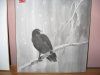
Rule of thumb for scrolls...number of chop marks

Cadillactaste

Neagari Gal
Messages
17,329
Reaction score
24,137
Location
... zone 4 (USA) lake microclimate
USDA Zone
5b
Now...I always assumed Japanese went for simplicity with their scrolls. I have been looking at some on a few auction sites. And some are covered in chop marks. Which puzzled me. For it seemed to distract from the actual art. (In my opinion) That said...could someone please explain the rule of thumb for chop marks on a scroll...as to how many can be placed on one? And the reasoning behind on having so many...
 

Attachments

  • image.jpg
    image.jpg
    17.6 KB · Views: 112
I agree with your comment. In my personal opinion, the entire scroll is too busy - even WITHOUT the chop marks. I am interested to hear more from our scroll experts.
 
That is strange. I don't claim to have a great amount of knowledge about these things, but my impression is that scrolls are supposed to be relatively austere, low-key, simple...yet the presence of all those red chops seems to be a direct contradiction to that idea, almost like the artist is advertising by placing his mark all over the image. It would be nice to hear an explanation.
 
That is strange. I don't claim to have a great amount of knowledge about these things, but my impression is that scrolls are supposed to be relatively austere, low-key, simple...yet the presence of all those red chops seems to be a direct contradiction to that idea, almost like the artist is advertising by placing his mark all over the image. It would be nice to hear an explanation.

Perhaps as part of a bonsai display or the tea ceremony (just guessing here) but most of the antique scrolls I see for sale on ebay are very similar to the one pictured above as far as content- trying to find one suitable for bonsai display is difficult to say the least. I suspect they are meant to tell a story all by themselves instead of being components in a larger display. As far as all the different chops, that seems a bit overdone in the scroll above, but I have seen scrolls with multiple chops prominently displayed.
 
Last edited:
One is likely the artist's chop. One of the smaller ones will be for the author of the text.

I dunno how it works for scrolls, but for Ukiyoe (Japanese woodblock prints) there will be chops for the publisher and another for the censor that passed on the print as being suitable for publication.

The pictured scroll looks more Chinese than Japanese to me.

As far as austerity versus detail and "busyness" goes, I think it depends on the use to which the scroll is intended to be put. A stand-alone scroll is likely to have more content than one designed as themed support in an overall display.
 
Good points concerning the intended use of the scrolls (I hadn't really considered that) and explanations of the various chops.
 
Many times scrolls are worked on in schools, each artist will sign the work as contributed. The calligrapher, the artist or artists. Many times with scenery scrolls many artists will contribute to the art. Many scrolls are the collaboration of artists as some paint scenery well while others contribute animals or birds to the scene. So a scroll with some calligraphy, some mountains or water with an animal or birds may have been worked on by three or four artists all signing the work.
 
Often an artist might also have multiple chops describing who they are and where they come from. They may have a chop for own their name, one for their family's name, one for the region from which they live, one for a particular title. Then sometimes there are chops for certain periods in time, or times when particular rulers were in power. Then there can be chops which are referred to as mood chops, which help describe a particular feeling that an artist might want to portray. Often, these are comprised from various lines in historical poetry or philosophy. So, if one has a painting of a bird, they might use a mood chop, that describes a bit of poetry about how the wind gently blows through the trees on a beautiful autumn day.

So, to make a long story short... No set rules for the amount of chops.
I have seen artwork with one and I have seen artwork with hundreds.

That's pretty interesting and surprising to me. Sounds like it would be roughly equivalent to an American artist who paints landscapes, signing their name in big letters and bright colors in the sky, instead of in a somewhat obscure corner. And then the person who frames the work also would sign in the sky, as would the gallery owner who sold the painting, etc. And then you'd write where it was painted, who the president was, etc.
 
That's pretty interesting and surprising to me. Sounds like it would be roughly equivalent to an American artist who paints landscapes, signing their name in big letters and bright colors in the sky, instead of in a somewhat obscure corner. And then the person who frames the work also would sign in the sky, as would the gallery owner who sold the painting, etc. And then you'd write where it was painted, who the president was, etc.

Chris...that's sort of how I seen it as well.
 
Side note... often a lot of the scrolls on ebay that are for sale are not actual real art. They
are just reproductions that have been machine printed on scrolls, also... just like mass produced Bonsai, there are literally businesses that have hundreds of employees sitting in a room day in and day out mass producing hand painted scrolls. So, yes they are hand painted, but the quality of the art is one the level of a big box store ginseng ficus. Unless the scroll is battered and worn, most anything of any quality is going to cost some money, as it should. A five dollar scroll is worth five dollars.

I could be wrong, but I am pretty certain that the image on the scroll you have pictured is not an original. Looks very familiar... Also, as has been stated
before, this is not a Japanese Scroll... The scene depicts the Huangshan Mountain range in China, birthplace of Bonsai... But, it is most definitely Chinese.

I agree...it's a cheap reproduction on a good day. I am considering hanging some sort of art possibly in the cold greenhouse. My concern is...the conditions will destroy a good piece of art. So I am looking for a cheaper quality piece. If it becomes destroyed...no huge concern.

Scrolls that hang horizontal confuse me as to how they are displayed. Unless they are displayed like a table runner? I seen some of them as well.
 
I've mentioned before that i have a particularly talented sumi-e artist that does my shikishi scrolls for tokonoma display. she was trained in japan and only places her mark on the
side, right or left, depending on where she sees the movement or flow of her work going. This is particularly helpful in setting up the display. The mark itself can be top or bottom depending on the placement of the subject.

I agree with the others that the scroll displayed is NOT Japanese. And yes I could see something like this used in a display singularly during a tea ceremony where the script discribes a theme and does not have to work with other items.

The crow I have used as an example, is often placed in my tokonoma with a leafless deciduous tree bonsai. Occasionally I might use
a suiseki of snow capped mountains along with the display but over time I'm learning less is more in the effort to make it totally an understatement.

I don't consider myself the judge of a good display, rather seeing the reaction of the quest to see how well they "get it".

Surprisingly, as hard as I try to get books and instruction from Japan on bonsai display, I have found the book by UK artist Paul Goff, entitled methods of bonsai display, to have helped me the most in learning. :)
 

Attachments

  • IMG_2531.JPG
    IMG_2531.JPG
    43.4 KB · Views: 50
Actually what is pretty interesting is why does this bother you so???
I mean, this is the second thread that you are now voicing objection too...
You have stated before, that you don't appreciate scrolls, and don't appreciate chops,
or the use of chops... So, cool... why get upset with the amount used then?
Seeing that even the use of one chop, is not your cup of tea ? Seems a little silly.

Side note... for most into this form of art, the chops are art themselves. It is not
about just writing someone's name as you have suggested. So, no... your "American"
vision is not accurate. If you were to view new things without your blinders
on, you might learn to come to respect how and why other cultures do things.
Instead of just passing judgment, and telling us how you don't like something you
do know anything about.

What is really interesting is that you are keeping track of my comments!

Anyway, since I am an American, that is my viewpoint. I'm asking questions and making observations in order to attempt to understand the differences. Knowing that the Japanese consider chop marks to be "art themselves" helps with that. Some western painters are also know for flamboyant or artsy signatures, but I generally don't care for that as to me, it makes the piece more about the artist and less about the painting.

Anyway, thanks for the additional information, despite the overall snide tone of your reply.
 
And then the person who frames the work also would sign in the sky

If the hyougushi signs anything as to identify who made the scroll, it would be on the backside upper corner near the half moon or half round dowel called hassou in Japanese....embedded on a different type of paper than that used to back the cloths and paper. They do not put their hanko directly on the artwork according to my understanding and what I have read.

Hope that clarified at least that point...
 
If the hyougushi signs anything as to identify who made the scroll, it would be on the backside upper corner near the half moon or half round dowel called hassou in Japanese....embedded on a different type of paper than that used to back the cloths and paper. They do not put their hanko directly on the artwork according to my understanding and what I have read.

Hope that clarified at least that point...

But it would still be visible on the front side of the piece, even if not directly on the artwork? Kind of like if a western framer signed or stamped a mat on a watercolor painting?
 
But it would still be visible on the front side of the piece, even if not directly on the artwork? Kind of like if a western framer signed or stamped a mat on a watercolor painting?

Sorry I did not explain clearly. If it exists it is on the backside of the scroll and not visible to the viewer when hung...
Your example is not pertinent to this situation.
 
Oops, sorry - missed the "backside" in the previous post. Thanks for clarifying.

Chris
 
If the hyougushi signs anything as to identify who made the scroll, it would be on the backside upper corner near the half moon or half round dowel called hassou in Japanese....embedded on a different type of paper than that used to back the cloths and paper. They do not put their hanko directly on the artwork according to my understanding and what I have read.

Hope that clarified at least that point...

This makes more sense...since I prefer simplicity over confusion. Thanks for adding more to the thread explaining. So hyougushi is Japanese scrolls then...so then you see more chops on the front of say a Chinese scroll then verses Japanese? Am I reading this all correctly.
 
This makes more sense...since I prefer simplicity over confusion. Thanks for adding more to the thread explaining. So hyougushi is Japanese scrolls then...so then you see more chops on the front of say a Chinese scroll then verses Japanese? Am I reading this all correctly.

Hyougu is a generic term for a hanging scroll. A hyougushi is someone who makes the scrolls. These are all theJapanese terms as I do not know Chinese.
As to more chops on Chinese versus Japanese scroll, I am unsure. I mounted a work in 2011, which was from a Chinese artist, but has no chop at all. I can not copy the link on this device, but you can search for it on my blog at www.wallscroll.blogspot.com.
 
Just Lovely
 

Attachments

  • 4ptgalbx.jpg
    4ptgalbx.jpg
    17.3 KB · Views: 45
  • 4yammian.jpg
    4yammian.jpg
    58.9 KB · Views: 48
Back
Top Bottom