Can you give me a precise, accurate definition for the term literati bonsai?

a circular argument to re defile or dilute the true definition to American standards
A common occurence here.. 🙏

I just love an answer that explains how one answer is absolutely wrong without lending any understanding to a correct answer
🤔


Pretty lazy content for so many words.
Yet you offer a lot of substance trying to answer the question?
 
Please share your own definitions, and feel free to explain why you disagree with mine.

I should have been more clear. Please share your own definitions. If you do, please feel free to share why you think I am wrong.

Another somewhat-related point: I don't necessarily have a problem with the fight club philosophy, but it would be nice to get a bit more explanation. @milehigh_7 did explain by drawing an analogy to academics living in a bubble, so I'll try to respond to that.

A good contract usually begins with a definition section to clarify key terms. Without stipulating definitions, the judge will choose how to define the terms. We just discussed what happens when judges are left to define the term literati. Imagine how much more contentious that would be with a million dollars at stake. We need to define our terms because different people with different backgrounds use the same terms differently. Try ordering biscuits and gravy in the U.K. I'm trying to do something similar here. I'm stipulating a definition, and I want to know what others think.

By contrast, academics live and work in a bubble in which everyone has learned the same definitions to key terms in their undergraduate and graduate coursework. If we were in bonsai school, we would be quizzed on the styles in our first year, and we would have memorized functionally identical definitions. Have you seen the meme about the mitochondrion?

Outside of Japan, we tend to learn the basics from books and/or YouTube. The average quality has risen greatly lately, but it is still a mixed bag. Even amongst the good books and videos, artists have different takes on similar subjects. If we all just focus on our own bonsai, then we're guaranteed to face major controversies in the future. We can't have a community if we can't communicate.
 
Last edited:
It’s literati “inspired”….if
Not literati, how would you classify this tree you mention?
This tree is stunning and I certainly would not change a thing.
It has a slender trunk with irregular movement and limited taper so seems to be fitting into the literati category until I get to the crown where it is lush and full of zeal. Foliage over 2/3 the height of a tree.
If this was in my collection I would be pretty excited to call it an informal upright..but I suppose I would be wrong.
 
Having said the above, I typically do not classify any trees into styles… I just do to them what feels like a fit for the tree. I would never remove a branch or wire something just to fit it into a category.. but in this chat we are discussing definition.
 
This tree is stunning and I certainly would not change a thing.
It has a slender trunk with irregular movement and limited taper so seems to be fitting into the literati category until I get to the crown where it is lush and full of zeal. Foliage over 2/3 the height of a tree.
If this was in my collection I would be pretty excited to call it an informal upright..but I suppose I would be wrong.

I would also call it an informal upright. The current trend in bonsai is trees with fat trunks. Anything with a slender trunk looks literati by comparison.
 
Having said the above, I typically do not classify any trees into styles… I just do to them what feels like a fit for the tree. I would never remove a branch or wire something just to fit it into a category.. but in this chat we are discussing definition.

Absolutely. The words should fit the tree. The tree should not be changed to fit the words.
 
A common occurence here.. 🙏


Yet you offer a lot of substance trying to answer the question?
Perhaps you misunderstood, this is commentary on a post referring to the original question. Very similar to your commentary in response to my post… and so the cycle continues.

Also, I saw @Potawatomi13 ’s response to my little dig and I think it adequately fleshed out why they chose to respond the way they did.

*edit to add; I’m reading all this to get a better grasp and gain understanding as well. I will not be so bold as to add to what has already been said. For me the earlier post which quotes [sic] I know it when I see it, really sums it up.
 
Last edited:
Perhaps you misunderstood, this is commentary on a post referring to the original question. Very similar to your commentary in response to my post… and so the cycle continues.
you missed the point where I indeed did try to answer the original question, where you only seem to pop in to object against someone posing an answer. But sure.
 
you missed the point where I indeed did try to answer the original question, where you only seem to pop in to object against someone posing an answer. But sure.
Pump the brakes Jelle, I was just responding to your response to me specifically. Please take no offense. I read your other posts an thought they were quite apt.
 
I don’t think any kind of art can be accurately explained or defined.
This. And @milehigh_7's explanation, rather than a hard and fast definition, an abstract "feeling" or maybe more like a mosaic or spectrum that encompasses a broad range of qualities, and which overlaps other styles on multiple sides. This explains for myself why I haven't been able to formulate a "literati" mental image for myself.
Forgive my beginner ignorance, but I like the image conjured of "academics in a bubble," a tree entirely unconcerned with the rest of the world around it. Its only concern is to reach enlightenment, growing in and around the forest, unaware whether or not it affects those around it, striving for nothing other than knowledge and wisdom.
The thing about abstraction is its subjectivity; it is defined in the eye of the artist, or in the eye of the beholder. And this is why there will always be debate: no perspective is like any other.
 
Last edited:
I don’t think any kind of art can be accurately explained or defined.

Nothing can be accurately explained or defined. Words will always fall short of the phenomena they describe. That's what the entire field of semantics is about. It doesn't mean we should give up on speech. It just means we need to be careful with our words—especially when the subject is nuanced.
 
I am not the authority. I point to those who are (Ryan and Michael). The demo trees Ryan made were excellent examples to use for this thread. I can see what is NOT Literati/Bunjin but my definition would be lacking to say otherwise.

I find this a strange thing to say. If you know how to use a word, that means you have your own working definition for it. Please share it.

Working my own Literati I do it by removing what makes my tree non Literati. Perhaps working backwards to reach the goal.

Please share a photo. I would love to see what you're talking about.

I see this thread as a circular argument to re defile or dilute the true definition to American standards. Be happy😌.

This thread is not a circular argument. You seem to be redefining or diluting the true definition. Notwithstanding, language works on consensus. A word has a meaning because everyone agrees on the meaning. Where people use the same word in different ways, it ceases to be meaningful. Minor variations will not utterly destroy the usefulness of the word, but it will require clarification when you use that word. (Which is why I tend to lean toward prescriptivism.) This thread is an attempt at a consensus so we can have intelligible conversations, rather than talking past each other.

Frankly, I'm disturbed at the number of people showing up to complain that this thread exists. This is a bonsai forum. I thought we were all here to discuss bonsai. How can we do that without a shared language? I expected snarky comments about my theological analogy. Instead, I'm seeing comments that we should not be discussing the concept of literati bonsai at all. What are you doing on a bonsai forum if you're not willing to discuss bonsai?
 
I am aware we're arguing semantics. It's in the title of the thread.
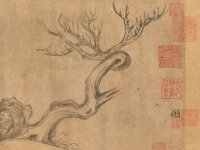
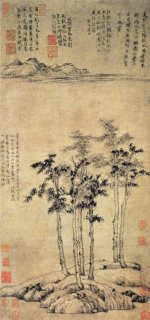
So the roadblock to a "definition" is, what we now consider "literati bonsai" was adapted in abstract from paintings (like those attached) by later Japanese artists, then adapted to actual tree styles again in abstract as a "concept" or representation of an artform not a 1:1 copy. There is a lot of history about these artists and the culture at the time that went into the paintings that the later Japanese masters wanted to represent in concept. Much like trying to read ancient literature anachronistically (my specific area of study), we should not, no... can not, squeeze them into our 2025 nice tidy boxes. of if it has an extra branch here or too much foliage there it's out... You have to think philosophy here and take your rigid rule book and toss it.


Li Sixun 651-716.jpgSi Sjo 1037-1101 56mil.jpgni-zan_six-gentlemen.jpgWu Zhen - Fishermen in Reclusion at Dongting.pngHuang Gongwang -  Dwelling in the Fuchun Mountains.png
 
This. And @milehigh_7's explanation, rather than a hard and fast definition, an abstract "feeling" or maybe more like a mosaic or spectrum that encompasses a broad range of qualities, and which overlaps other styles on multiple sides. This explains for myself why I haven't been able to formulate a "literati" mental image for myself.
Forgive my beginner ignorance, but I like the image conjured of "academics in a bubble," a tree entirely unconcerned with the rest of the world around it. Its only concern is to reach enlightenment, growing in and around the forest, unaware whether or not it affects those around it, striving for nothing other than knowledge and wisdom.
The thing about abstraction is its subjectivity; it is defined in the eye of the artist, or in the eye of the beholder. And this is why there will always be debate: no perspective is like any other.

I think what you're getting to is Wittgenstein's family resemblance, and I think you may be onto something.

Also, I should point out the notion of academics in a bubble is pejorative. It means they're out of touch. There's a reason the number one piece of advice we give to beginners is to join a local club. Notwithstanding, I suppose you could draw an analogy to an ascetic living alone in a cave in search of enlightenment. I guess it's a tradeoff.
 
So the roadblock to a "definition" is, what we now consider "literati bonsai" was adapted in abstract from paintings (like those attached) by later Japanese artists, then adapted to actual tree styles again in abstract as a "concept" or representation of an artform not a 1:1 copy. There is a lot of history about these artists and the culture at the time that went into the paintings that the later Japanese masters wanted to represent in concept. Much like trying to read ancient literature anachronistically (my specific area of study), we should not, no... can not, squeeze them into our 2025 nice tidy boxes. of if it has an extra branch here or too much foliage there it's out... You have to think philosophy here and take your rigid rule book and toss it.


View attachment 624376View attachment 624377View attachment 624378View attachment 624379View attachment 624380

Now we're getting somewhere. I like this explanation. That said, I do not think it precludes a definition. It just means the definition will be vastly more complex. See my prior comment about family resemblance.
 
I think what you're getting to is Wittgenstein's family resemblance, and I think you may be onto something.

Also, I should point out the notion of academics in a bubble is pejorative. It means they're out of touch. There's a reason the number one piece of advice we give to beginners is to join a local club. Notwithstanding, I suppose you could draw an analogy to an ascetic living alone in a cave in search of enlightenment. I guess it's a tradeoff.
I'll give you and example of the "bubble" thing. If you have ever been around biblical scholars, OT guys are normally super limited on their "expertise" on the NT texts and vice versa. It's extreme specialties with concepts and jargon understood within the community and if you want to swim in their pond, you have to take your own swimming lessons many times. Also some of the artists in the pictures that I posted were loyalists of one Dynasty and when the next crew came in they became fugitives often resorting to a live as a monk in the high mountains and from that came the art. It can be taken as pejorative I guess but it's also true if you've been around them and from this came the term "ivory tower", which while pejorative is somewhat descriptive. I recall the difficulty of preparing a sermon that parishioners would actually care about after grad school. I was so used to the (forgive the bluntness) "mental masturbation" of grad school that making things practical became difficult.

My overall point was that, in general terms a "master" (not me by any definition) would understand the "essence" of a "literati bonsai" but likely not be able to put it into a bullet point definition. Allow me expand on that a bit:

Let's compare and contrast two bonsai styles in terms of two philosophical schools of thought. First, let's start with a formal upright, (chokkan). It has an extremely specific definition from which, one cannot diverge without breaking the style. This style is rather Aristotelian in nature as it is empirical, categorical, rule-bound. You can teach this style through explicit instruction and evaluate success against measurable criteria.

On the other hand we have literati or bunjin style bonsai which exist more in a Platonic school of thought. For him, Forms were the perfect, abstract ideals, the "chair-ness" of all chairs, the "beauty" behind all beautiful things. Physical objects are imperfect shadows or participations in these eternal essences. You can't point to the Form itself; you can only recognize its presence in particulars through reason and intuition. Literati bonsai operates similarly. There is no checklist. No prescribed trunk angle, no required number of branches, no specified pot shape. What exists is an essence, a feeling of elegant struggle, austere loneliness, scholarly defiance of convention. You recognize a literati tree the way you recognize melancholy in music, not by measurement, but by resonance with an ideal that exists somewhere beyond the physical specimen. So you can say at the end of the day that it is "defined" by what it "evokes" rather than what it "contains". Sure it has generally agreed upon elements:
  • Sparse, not lush
  • Tall and reaching, not grounded
  • Imperfect, not symmetrical
  • Suggestive, not declarative
I would say it returns us to were we started in this discussion with your Justice Potter Stewart quote. Thus as @Michael P suggested, go work on your trees and create something that "evokes" the feeling you are after. If successful, call it literati (it may very well fit into another more literal (see what I did there) category as well) . Truth be told, your own personal definition that you started in the beginning is quite functional in my opinion.

 
Last edited:
Back
Top Bottom