Do It Yourself

And is the drainage hole too large? The pot is about 2 1/2 inches in diameter and about an inch tall.
I feel like it's too large and you may have to water constantly. Maybe make feet so the water that does drain doesn't stay trapped under the pot.
 
Wow! I've loved woodworking since I was a kid, but I've never made anything close to that nice. Beautiful.
You will laugh, but I swear half the time I see photos of people working on their trees in the winter, in their basements/garages, I see woodshop tools in the background :)
 
I feel like it's too large and you may have to water constantly. Maybe make feet so the water that does drain doesn't stay trapped under the pot.
I'm glad you said so. I was thinking the same.

I can easily make an insert to provide a smaller hole.
The reason it's as large as it is.... is because with each cut, I can make progressively smaller pots from the same material. In the future I won't make them that large.

I think I can make this work though, using dirt instead of akadama, etc...
Seems like dirt holds water longer.
 
I'm glad you said so. I was thinking the same.

I can easily make an insert to provide a smaller hole.
The reason it's as large as it is.... is because with each cut, I can make progressively smaller pots from the same material. In the future I won't make them that large.

I think I can make this work though, using dirt instead of akadama, etc...
Seems like dirt holds water longer.
Yeah i had that thought as well to use fully organic soil that would retain water.
 
Did you steam bend the chair back slats, or were they cut to that shape? It really is beautiful.
Each back brace is a "sandwich" of sapele (the dark wood most of the chair is made out of) and a core of ash. Ash is a very supple and bendable wood (think English longbows). The back braces are floating in the frame of the chair, so when you lean back in the chair they will bend to fit your back.

To get the bend exactly right, I first cut the curve out of a thick piece of ash (with holes so I can insert c-clamps), then I made a rigid clamping stock out of several thin pieces of ash that I clamped to the curved wood form. Then it was as simple as cutting a bunch of 1/8" strips of sapele and ash, and gluing them up like a sandwich, sticking them in the form, and clamping them super tight:

back-braces.jpg

I needed 7 back braces for the chair, but I made 8 just in case I needed an extra. Two at a time, so it took four days to clamp up the back braces (letting them set for 24 hours before I took them out of the form). I worked on the frame of the chair at the same time.
back-braces2.jpg
 
Last edited:
Each back brace is a "sandwich" of sapele (the dark wood most of the chair is made out of) and a core of ash. Ash is a very supple and bendable wood (think English longbows). The back braces are floating in the frame of the chair, so when you lean back in the chair they will bend to fit your back.

To get the bend exactly right, I first cut the curve out of a thick piece of ash (with holes so I can insert c-clamps), then I made a rigid clamping stock out of several thin pieces of ash that I clamped to the curved wood form. Then it was as simple as cutting a bunch of 1/8" strips of sapele and ash, and gluing them up like a sandwich, sticking them in the form, and clamping them super tight:

View attachment 625501

I needed 7 back braces for the chair, but I made 8 just in case I needed an extra. Two at a time, so it took four days to clamp up the back braces (letting them set for 24 hours before I took them out of the form). I worked on the frame of the chair at the same time.
View attachment 625502

Actually, very much like making a bow. Cool.
 
The chair is beautiful. Some fine front porch sitting to be had. Making a bonsai stand must be a piece of cake for you.
I haven't made one yet because I will still working on stuff for the house. I have a few ideas I am looking forward to trying out. Working on smaller pieces gives you a little more latitude to work with finer woods without bankrupting you :)
 
That's a 'cheap' knife? A simple design, but looks like it's neo-Damascus steel, maybe even hand forged.

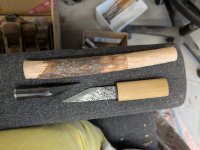
That’s a kiradashi. It’s a relatively inexpensive craft knife in Japan. They’re usually hand forged. It’s one of the first things a Japanese blacksmith or swordsmith typically learns how to make. They come in a few different shapes/styles and you can get them with a wood sheath and handle as well. You can pay a lot for one from a very famous smith or something like that, but usually they're affordable.

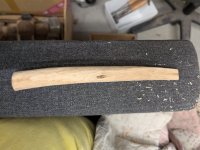
To keep it on topic, I carved a handle for a genno (Japanese metal hammer head) with one of my kiradashis the other day. I used a bit of chokecherry from the back yard that I had been drying for a year or two.

PXL_20260104_234654835.jpg
PXL_20260105_041304184.jpg
 
That’s a kiradashi. It’s a relatively inexpensive craft knife in Japan. They’re usually hand forged. It’s one of the first things a Japanese blacksmith or swordsmith typically learns how to make. They come in a few different shapes/styles and you can get them with a wood sheath and handle as well. You can pay a lot for one from a very famous smith or something like that, but usually they're affordable.

To keep it on topic, I carved a handle for a genno (Japanese metal hammer head) with one of my kiradashis the other day. I used a bit of chokecherry from the back yard that I had been drying for a year or two.

View attachment 625542
View attachment 625543
Cool. Are you a smith, as well as a bonsai enthusiast?
You'll have show a picture when it's finished.
 
Cool. Are you a smith, as well as a bonsai enthusiast?
You'll have show a picture when it's finished.

I’m not a smith, but I do woodworking as a hobby and obsessively collect vintage hand-forged Japanese tools and information about the blacksmiths that made them. I’m mostly interested in chisels, but I know a little about most of the traditional hand tools.

I’ve fit the head and just need to sand and oil the handle. I’ll try to remember to post another photo when it’s done.
 
Back
Top Bottom