Kievnstavick - Celtis occidentalis North America #1

Kievnstavick

Chumono
Messages
616
Reaction score
1,584
Location
Kitsap County, Washington State, USA
USDA Zone
8b
Hello all who's curiosity got the best of them and stepped into the Celtis Contest zone.

Although titled for a specific species, I have aquired from Sheffields seeds a select variety of Celtis that caught my eye (and were also available to purchase from my trusted source). I have approximately 50 each of the seeds.

This first forum post will be to document the germination process of the three species. Afterwards, I plan on making new threads for the different species. Once the seedlings are past their first potting up and make it through the summer, I'll make individual threads for a good selection if them that show the most promise.
20250203_050410.jpg

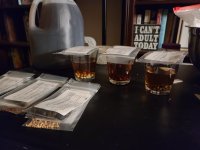
I received the seeds yesterday, but I didn't get to them until today.

I gave each packet of seeds a 30min soak in GA3 (ppm unknown as I kinda just winged it. It was approximately 1/32 tsp to one small baby food container of water). After the bath, I plopped the seeds into a humic acid and kelp solution to soak for 20-40 hours.

My current plan is to sow the seeds tomorrow after work into seed trays then leave them outside. I plan to retain about 5ea of the species to attempt breaking the seed coating and give it another long soak as a means of circumventing the dormancy requirement.

As I have approximately 60 days left of cold weather, we will see how these will germinate. It should be fine though.
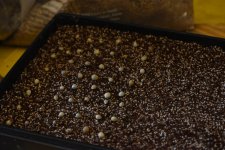
 
Today I planted the seeds into a 10x20 tray filled with a 50/50 mix of small-sized pumice and coco-coir.

DSC_1604.JPG

After the seeds were placed, I separated them with medium sized vermiculite (mostly because I didn't want to use my usual pumice for the barrier) as a way to visually tell where each species was sown. I covered the seeds with medium sized spahgum moss that I ground.

The seed tray will go outside tonight as I forgot to take the tray out while getting ready for work.

DSC_1609.JPG

In total I have:
55 Celtis julian
57 Celtis koraiensis (with a single floater)
64 Celtis occidentalis (North America)

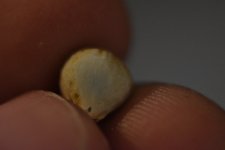
I took 5ea of the species aiming for the larger seeds for ease of holding and sanded through the seed coat to circumvent the stratification period. They were placed back into my solution for another 20ish hours.

DSC_1606.JPG

For the sanding, I used 100grit sand paper and removed the outer coating until I could just start seeing a colour difference. The sanded process involved a few passes over the sand paper. Stopping frequently to look for potential break through and to make sure I didn't over heat the seeds. I sanded in at least 3 spots to ensure that the swelling seed could break through the coating if the seed coating didn't soften enough.

DSC_1607.JPG

Pictured above is to show what sanding too much looks like. In this case I broke through the seed coat a lot quick then I anticipated. The seed itself doesn't look harmed, but I wouldn't be surprised if the cotyledon shows some minor damage once they sprout. Shouldn't be an issue as I have had seeds live with worse damage pre-germination.

My plan with these 15ea is to sow them into small pots and germinate them in my grow tent while I wait for the spring weather.
 
Here is my first update. I was getting a little antsy, so I went digging around in my pots to see what was going on.

Three cheers as I have signs of life (and skipping cold stratification) in the occidentalis pot. I snipped around and found 3 others opening as well.

DSC_1675.JPG

koraiensis shows no signs as of yet, but I am hopeful.

julian also shows no signs.

So I am either real lucky or I did something right.

On the other two species, there is a chance I did not go deep enough with the sanding. If there are still no signs of germination this weekend, then I'll sand the others a little bit more.
 
How are these doing?
I've been meaning to update these. Busy with life, maintaining my bonsai, and work.

My early start ones did not end up surviving. I have several in a seed tray that sprouted up. One species had a much better germination rate then the others, but I haven't paid attention to the tag to know off the top of my head.

I have been battling the local deer over what is an acceptable breakfest in my yard. I think my hackberries were an early victim. The deer have since found a preferred species to eat, but these are still subjected to trampling.

Which ever survive this year will get transferred to a nursery pot and styled.

Since I have tomorrow off, I can try to finally take pictures of my plants.
 
Here are the first emerged hackberries. There are quite a few while seeds still in the substrate that I am hoping will emerge next year. Initial identification might be hard given the deer have probably mixed the seeds around with their stomping. I may have lost a couple from deer grazing, but I did not keep tabs on them that closely.

First up are the Julian Hackberry. I have four that germinated this year and was also the least trampled side. Of the four, one has really taken off. It is probably being stunted a bit from the grow tray.

20250907_175338.jpg

Next is the common Hackberry. There are six seedlings. All of them have this droopy look to them. I don't recall at the moment if that is their natural growth habit or if I got a weird gene.

20250907_175257.jpg

Lastly, the Korean Hackberry. I have 5 seedlings that emerged this year. This was also the side that saw the most deer trampling.

20250907_175229.jpg

I haven't decided just yet if I want to do a fall potting of these or wait until spring.
 

Attachments

  • 20250907_175229.jpg
    20250907_175229.jpg
    280.9 KB · Views: 0
  • 20250907_175257.jpg
    20250907_175257.jpg
    345.2 KB · Views: 0
  • 20250907_175338.jpg
    20250907_175338.jpg
    308.8 KB · Views: 0
Hey! Please submit your seedlings for the contest in the submission thread!! Thanks
 
Back
Top Bottom