
Oh God it's pathetic.It seems to come down to the argument about art and all the crappola we have hashed over for years around here. Nothing new has been said and for the most part minds have not been changed. For the sake of what we do around here and why this post came up in the first place depends on whether or not you are justified in judging other people's work without offering work of your own for the rest of us to treat in a like manner. If bonsai has in some small way given us mear mortals the opportunity to soar with the Gods in producing what we imagine as art really is not dependent upon you or your opinion unless you truly do believe bonsai is art. So--- if at some point you make up your mind what bonsai is or is not, you might become a bit less pedantic and a bit more generous in spirit in accepting what people do, especially if you still refuse to demonstrate your ability, your real ability not what you think you can do in time.
We have had people come around here from time to time that believe they have it all figured out even after two or three years. They are quick to tell us how we are doing this wrong and that wrong and how we have to do it this way and that way when in fact when pressed they only believe they know the secret of bonsai but don't have any yet. We used to have what we called the All Smoke No Fire Club for individuals that were truly legends in their own minds. Some of them were even students of well known teachers thinking just the association legitimized their position and level of skill.

You are using an out of date browser. It may not display this or other websites correctly.
You should upgrade or use an alternative browser.
You should upgrade or use an alternative browser.
The secret to growing bonsai. A thread inspired by Bolero.
- Thread starter Brian Van Fleet
- Start date

music~maker
Shohin
The thing is, I'm guessing most artists probably won't be able to answer your question. I know I can't. Art, for me, is the ultimate subjective idea. It's an ever-evolving definition, and just when you think you've nailed it, and locked it down, somebody will surprise you with something new. Who's to say that a band playing covers isn't producing art? I could strongly argue that the performance of other people's songs is still an artistic expression of that song.Can I ask just one thing of all you artists? Give me one example, just one, of something you think is definitely not art.
Music maker, I also was a music maker for a while. I played jazz and rock bass for 25 years. We played original music in one band. The rest of the time I played covers in other bands. (most bonsai are covers by the way - yes Eric a fact!) The only time I thought I was creating something (being an artist) was when I was asked to write a bass line by the keyboard player who composed the main music. That was mine, it was unique. I selected and arranged the notes. Other times I would sit at the piano and do a similar thing. Good or bad is not the issue. When I was playing covers, I did not feel I was doing art, I was repeating someone else's. Yes that is narrow definition but without that definition, there is no art. There is no such thing as a blurred line. A blurred line is no line. Just because we cannot easily grasp a concept does not mean it doesn't exist. You seem to be missing the point that if there is no line separating one thing from another both things are the same. Like Yin and Yang. One constantly evolving into the other. I'm not saying that I can tell for certain that every branch manipulated by someone on a tree is not unique but taking the overall outcome of the finished product, a vast majority of the time I can see that it isn't. That's what I 'm talking about. In a PRACTICAL sense. In a theoretical sense, I guess you could say there are ''degrees'' of art. Like someone playing covers as opposed to the one who created them. But we are not concerned with theoretical ideas when we look at trees. And THAT's why I think it's a waste of time trying to label bonsai as art. Even if there are some elements of it there.
So I ask once more. If you believe in art, and you think you can recognize it, give me an example of human activity which you can definitely say is not art.
Finally in practical terms look at these and tell me they are all art pieces. if that's not enough, look at a thousand more.
https://www.google.com.au/search?q=...=1920&bih=910#tbm=isch&q=bonsai+pine+&spf=427
Just like the many, many bonsai that are "cover songs" as you say. You may not think it's unique or original, but it's still somebody's artistic expression.
The idea that without narrowly defining art, there is no art, is just crazy to me. Art is ultimately what people say it is. Not what you or I say it is, but what they say it is. The very definition of art lies in the eye of the beholder. Case in point: there are many people who think that various types of modern art are not art. But others think that such works not only are art, but that they are brilliant! Who's right? Who gets to decide?
For me, it seems that unless somebody is assigned the role of final arbiter of what is or is not art (which is patently ridiculous), then as soon as somebody declares something art, it kind of by definition is art.
I know this probably isn't a satisfying answer for you, and I know that there are many traditional definitions of what art is in certain formats disciplines, but I think one could broadly apply the term "art" to just about anything, and certainly something where one is creating something like a painting or a song or a bonsai tree. Even if they're creating their best version of what's been done before, they're expression of it could easily be defined as art.
I may have a particular perspective on what's good art, and I could even argue why I believe that, but I don't feel I have the right nor do I see any real point in declaring something "not art". It doesn't seem to serve any real purpose to do so. I somebody wants to scribble in crayon on a piece of paper and hang it on their wall, or if they want to paint a perfect replica of the Mona Lisa, and want to call those things art, then who are we to tell them it's not? Maybe they see the act of creating those things as the art more than the final output itself. Who knows?
Defining art is just such a slippery thing, and proving a negative is practically impossible.
music~maker
Shohin
Despite the rat holes, this was a great idea for a thread @Brian Van Fleet.
I'm going to skirt the rules a bit and submit multiple photos for each because I think it better illustrates things. For me, the pinnacle of bonsai are trees that make me believe them. Trees that I could imagine actually occurring in nature.
I would submit any number of trees from @Walter Pall in this regard. I love the naturalistic style, and his deciduous trees often remind me of trees I see around me where I live.

On a related, but slightly different note, I could submit any number of trees from Dan Robinson. They tend to be wild, rough, and reminiscent of ancient trees one might run into an old growth forest somewhere. Not surprising, either, given that he collects most of his from the wild.

I started in this hobby over 20 years ago, but spent the first 10 years essentially just trimming branches and not really understanding how one gets to these kinds of end states. 12 years ago, I set out to figure it out, and I've been working on the intricacies of developing trunks and branches ever since. I wanted to truly understand what it takes to develop every aspect of the tree.
I feel like this is a lifetime project at this point, but I have definitely made progress in various areas on various trees. The biggest thing I've discovered is that setting a tree up at a particular scale, then gradually scaling it up and occasionally scaling it back down again seems to be a recipe for consistently interesting and natural trunks and branches. It's kind of what happens to natural yamadori that have been browsed by animals, except with a lot more intention. So that's my answer to "what am I doing about it?" In the past few years, I've been seeking out new material that's further along in the trunk department so I can get to finished trees sooner, but some of the trees I consider my best are ones that I have developed from very early stages.
For example, this juniper may not look like anything too fancy:
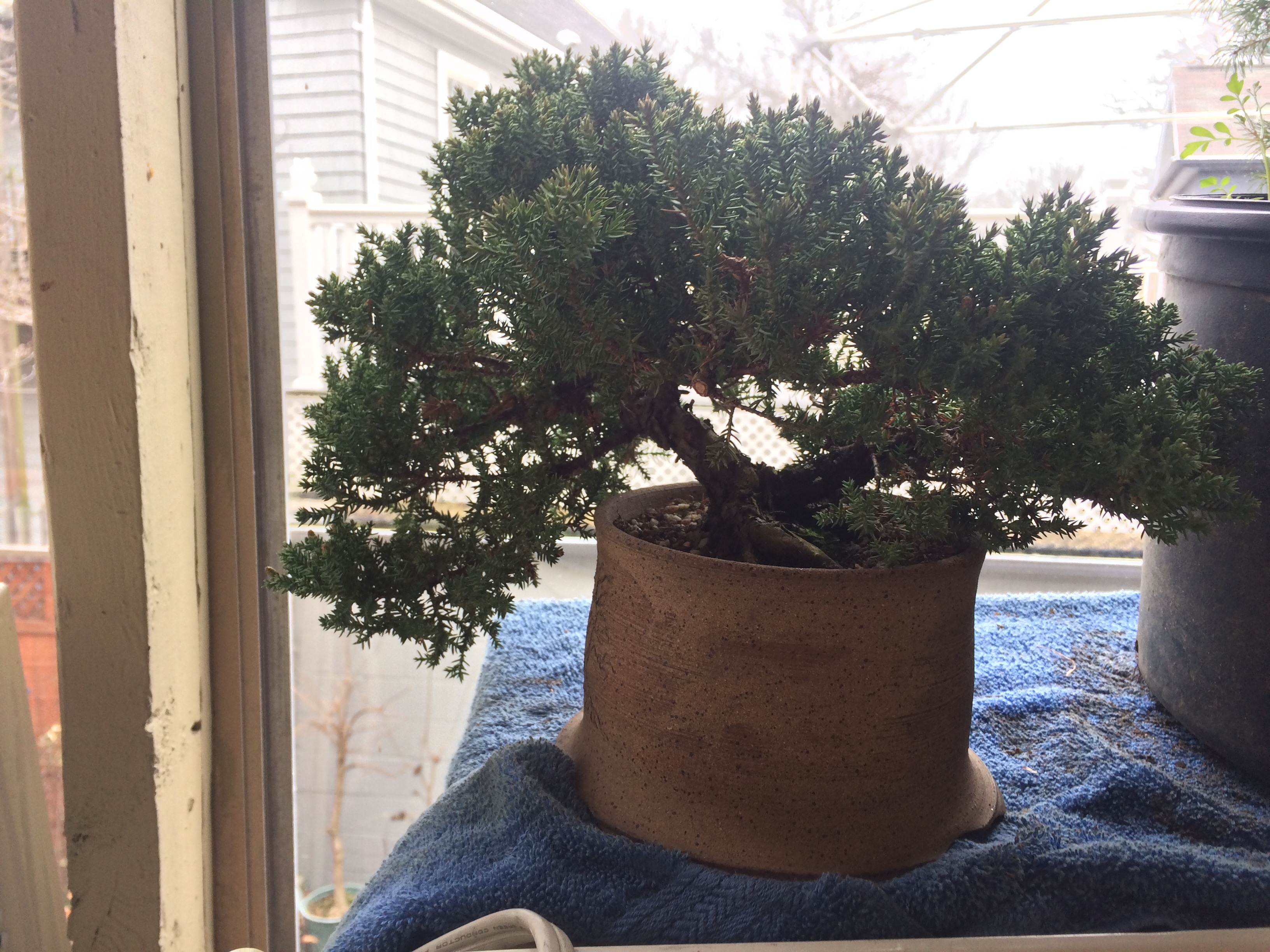
But I did grow it from this state over 7 years:

And I know every branch on that tree, and there's nothing currently there that isn't serving some purpose. Once I have sufficiently scaled it up into the pre-bonsai material I really want, I plan on really adding some age to it. But I'm in no hurry at all.
Similarly, this acer has tremendous potential to eventually be a good tree, and I consider it one of my best, but it probably doesn't look like so much now:

Unless one considers that I re-grew the entire thing from this over a similar timeframe as that juniper:

So given the path I took in each case to get from point A to point B, I have a pretty good idea for where and how I'm taking them to point C. But by a lot of people's subjective standards, they wouldn't look like much as is. But I was there for their past and I can see their future, if that makes sense.
But I guess I wouldn't consider these my current best on my bench, since I know what a long way to go they still have. That title probably goes to the little seiju elm in the middle in this photo:

It's also the one in my profile photo. Of the trees I have, I think that one currently most accurately depicts a miniature tree at scale that makes me believe it's a larger tree. I have quite a few like the two I showed above that will probably catch up and significantly exceed this in another 5-10-20 years or so, but as you know, developing trunks takes time. =)
My inspirations will continue to be other people's trees that actually look like trees, and more important, actual trees in nature that I find interesting. Nature has left behind a hell of a crib sheet if one stops and looks around.
Thanks again for the thought-provoking thread.
Looks like some of my pictures didn't come through and now the post is locked. Let's try again with on-site media storage.
This was the juniper I was referring to:
View media item 3303
This was the maple:
View media item 3305
And this was the seiju elm:
View media item 3304
Defining art is just such a slippery thing, and proving a negative is practically impossible.
Can't prove a negative, can't prove it's positive. Thanks, you've proved me no more wrong than all those criticizing me.
Anyhoo.....
My inspiration? Take your pick.
Something like this kind of thing

or this

disincentive. something to avoid...
this

My best tree? I don't know but one of the more developed.

Work needed?
Every twig on every branch must be ascertained for it's importance and removed if necessary.
Branch tips are too dense after defoliation and need to be thinned by about 50% while maintaining the reach of the outline of the tree.
Of the remaining 50%, probably 30% of those will need to be wired into position.
There is also a glaring problem in the crown but I will leave that for others to notice and mention if they care to.
Do I consider it art? No.
Do I consider the trees above it art. No
Will anyone change my mind? They can try.

Smoke
Ignore-Amus
So far....
....based on recent events in this thread, I have steered clear of posting. I have many trees to post, many of them have been seen here for so long they get monotonous.
Since this seems to be a thread whereby one shows an example of a tree you find masterpiece worthy or inspirational, I find it odd that since the whole point of posting your own work is to see how one treats the material over time and how they have progressed based on their inspiration. So with that, why no before photo's?
For instance (caveat: in my experience I fully understand the work needed to keep a more finished tree in top condition, so don't throw that back at me, I get it) How have you developed over a number of years to bring a tree to fruition from nursery material or collected material (urban or mountain), or fresh dug material from a field.
Above, after a verbal beat down, Mike S has shown a nice naturalistic piece. I like it. Purchased or built from the ground up? Can you back it up with photo's or do we just commend you on your ability to spend money? That's the way I see it......
Here is a tree that I aspire to:

Some of my recent work:

....based on recent events in this thread, I have steered clear of posting. I have many trees to post, many of them have been seen here for so long they get monotonous.
Since this seems to be a thread whereby one shows an example of a tree you find masterpiece worthy or inspirational, I find it odd that since the whole point of posting your own work is to see how one treats the material over time and how they have progressed based on their inspiration. So with that, why no before photo's?
For instance (caveat: in my experience I fully understand the work needed to keep a more finished tree in top condition, so don't throw that back at me, I get it) How have you developed over a number of years to bring a tree to fruition from nursery material or collected material (urban or mountain), or fresh dug material from a field.
Above, after a verbal beat down, Mike S has shown a nice naturalistic piece. I like it. Purchased or built from the ground up? Can you back it up with photo's or do we just commend you on your ability to spend money? That's the way I see it......
Here is a tree that I aspire to:
Some of my recent work:

Tentakelaertje
Omono
Can't prove a negative, can't prove it's positive. Thanks, you've proved me no more wrong than all those criticizing me.
Anyhoo.....
My inspiration? Take your pick.
Something like this kind of thing
View attachment 141963
or this
View attachment 141962
disincentive. something to avoid...
this
View attachment 141964
My best tree? I don't know but one of the more developed.
View attachment 141965
Work needed?
Every twig on every branch must be ascertained for it's importance and removed if necessary.
Branch tips are too dense after defoliation and need to be thinned by about 50% while maintaining the reach of the outline of the tree.
Of the remaining 50%, probably 30% of those will need to be wired into position.
There is also a glaring problem in the crown but I will leave that for others to notice and mention if they care to.
Do I consider it art? No.
Do I consider the trees above it art. No
Will anyone change my mind? They can try.
I really like that tree. Not as good as your plum, but still, I like it a lot.
It does seem a bit instable though. The first branch on the left is imo not heavy enough to counterweigh the crown, but I think it could easily be solved by bending to crown a little back towards the left. If that's possible.
Why don't you think your tree art?
"Smoke, post: 447696, member: 66"]
Above, after a verbal beat down, Mike S has shown a nice naturalistic piece. I like it. Purchased or built from the ground up? Can you back it up with photo's or do we just commend you on your ability to spend money? That's the way I see it......
A cutting. You can take my word for it....if you want. As I already said, I have never bought a tree. That's a bore.

That's an interesting observation. I've always regarded the ''first branch'' as a second trunk. I can see how the crown moving left could be an improvement. It cannot be bent. It must be re-grown. That means starting again. I don't know if I would bother. Maybe removing some of the small trunk might help. Maybe not.I really like that tree. Not as good as your plum, but still, I like it a lot.
It does seem a bit instable though. The first branch on the left is imo not heavy enough to counterweigh the crown, but I think it could easily be solved by bending to crown a little back towards the left. If that's possible.
Why don't you think your tree art?
Not art because it's a copy of a million other Japanese trees that I have seen. But that's not important to me. What is important is that the tree gets better.


Tentakelaertje
Omono
That's an interesting observation. I've always regarded the ''first branch'' as a second trunk. I can see how the crown moving left could be an improvement. It cannot be bent. It must be re-grown. That means starting again. I don't know if I would bother. Maybe removing some of the small trunk might help. Maybe not.
Not art because it's a copy of a million other Japanese trees that I have seen. But that's not important to me. What is important is that the tree gets better.
View attachment 141971
It can also be a second trunk yes.
Is it a copy or an emulation? I can't remember having seen an exact copy of this tree.
Is the top not movable by rebar either?
If no, then maybe don't bother indeed. Or do bother if that enables improvement.

sorce
Nonsense Rascal
What happens when someone finds proof that (insert artists name here, artist who's name you know...ahem...but who's work you do not ) had a guy locked up showing him how to paint...or carve...
And they were copying it!
Art is copy.
Those pictures on cave walls were sights copied from the landscape.
It been that way ever since.
Copied, evolved.
So.....
There is no art.
Never was.
Sorce
) had a guy locked up showing him how to paint...or carve...And they were copying it!
Art is copy.
Those pictures on cave walls were sights copied from the landscape.
It been that way ever since.
Copied, evolved.
So.....
There is no art.
Never was.
Sorce
jacob letoile
Mame
@MichaelS
I wrote this to Bolero once. There is no thing that is art. Art is a property of the viewer, not the creator, nor of the thing being viewed. From a society level it could be considered an emergent property. If enough people say it's art, it gets called art.
If your definition of art is that it must be uniquely from the creator, that is just as much a cop out as any other definition you rail against. I don't know you, I have never heard you play base but I guarantee you have never written a completely original base line in your life. That's not how human brains work. Our brains, every one of them builds on what they know. When we make something 'new' it is never anything more than a response to what we have seen and experienced before. Your just as derivative as anyone else, your just more skillfully derivative than most. You are as predictably connected to cookie cutter bonsai as everyone you rail against, you just don't like them and respond to that by trying to make not cookie cutter bonsai. Your influences are no different than adairs you both are driven by the trees in nature and the bonsai you see around you, you just move in a different direction. A difference of degree, not of kind. Where I see you passing people off is by not recognising, despite your occasional conciliatory verbage, your framework is no more valid or inspired as theirs.
I may not know much about bonsai, but I can argue philosophy with amatures with the so-soist of them all day long.
I wrote this to Bolero once. There is no thing that is art. Art is a property of the viewer, not the creator, nor of the thing being viewed. From a society level it could be considered an emergent property. If enough people say it's art, it gets called art.
If your definition of art is that it must be uniquely from the creator, that is just as much a cop out as any other definition you rail against. I don't know you, I have never heard you play base but I guarantee you have never written a completely original base line in your life. That's not how human brains work. Our brains, every one of them builds on what they know. When we make something 'new' it is never anything more than a response to what we have seen and experienced before. Your just as derivative as anyone else, your just more skillfully derivative than most. You are as predictably connected to cookie cutter bonsai as everyone you rail against, you just don't like them and respond to that by trying to make not cookie cutter bonsai. Your influences are no different than adairs you both are driven by the trees in nature and the bonsai you see around you, you just move in a different direction. A difference of degree, not of kind. Where I see you passing people off is by not recognising, despite your occasional conciliatory verbage, your framework is no more valid or inspired as theirs.
I may not know much about bonsai, but I can argue philosophy with amatures with the so-soist of them all day long.

leatherback
The Treedeemer
Such a sham eto see a good idea for a thread go to pieces over the age-old question whether bonsai is art.
Why not stick to the topic at hand (Which trees do you find inspirational, what are your best trees and what are you doing to get to your inspirational trees with your own, without judgement as these are personaly opinions) and stop all this verbal abuse on opinions, which is exactly the opposite of the original intent of the thread.
Why not stick to the topic at hand (Which trees do you find inspirational, what are your best trees and what are you doing to get to your inspirational trees with your own, without judgement as these are personaly opinions) and stop all this verbal abuse on opinions, which is exactly the opposite of the original intent of the thread.

Cadillactaste
Neagari Gal
Might someone critique my favorite color...for I like fall colors, burnt red, and browns.I thought the purpose of this thread was to show trees that inspired you and what you felt was your best tree. No criticism necessary for peoples personal opinions. Some people like tropicals, some shutter at the thought. Some like purple, some like green. How could any be wrong?
 ...well said my friend.
Anthony
Imperial Masterpiece
Sadly, it is History that defines Art ----------------------- does what it say affect many over time.
Is the message universal.
Once again, just folk trying to give meaning to their wasted youth before they perish.
Bonsai is craft and until you can hang as a painting , lots of talk.
Art needs no explanations.
Darlene,
you like warm earthy colours, in the case of autumnal colours, it would suggest, some sadness about
ends, but perhaps contentment. There do exist paintings that are earth coloured and they are very
beautiful.
Beauty is truth revealed / unhidden.
Fare ye well oh Lady of the Twilight.
Anthony
Is the message universal.
Once again, just folk trying to give meaning to their wasted youth before they perish.
Bonsai is craft and until you can hang as a painting , lots of talk.
Art needs no explanations.
Darlene,
you like warm earthy colours, in the case of autumnal colours, it would suggest, some sadness about
ends, but perhaps contentment. There do exist paintings that are earth coloured and they are very
beautiful.
Beauty is truth revealed / unhidden.
Fare ye well oh Lady of the Twilight.
Anthony

Eric Group
Masterpiece
Can't prove a negative, can't prove it's positive. Thanks, you've proved me no more wrong than all those criticizing me.
Anyhoo.....
My inspiration? Take your pick.
Something like this kind of thing
View attachment 141963
or this
View attachment 141962
disincentive. something to avoid...
this
View attachment 141964
My best tree? I don't know but one of the more developed.
View attachment 141965
Work needed?
Every twig on every branch must be ascertained for it's importance and removed if necessary.
Branch tips are too dense after defoliation and need to be thinned by about 50% while maintaining the reach of the outline of the tree.
Of the remaining 50%, probably 30% of those will need to be wired into position.
There is also a glaring problem in the crown but I will leave that for others to notice and mention if they care to.
Do I consider it art? No.
Do I consider the trees above it art. No
Will anyone change my mind? They can try.
These are all nice trees, and all art.
The object is not to change your mind, you can believe what you want, just like the rest of us can. The object is to ask you to stop trying change OTHER PEOPLE'S minds.
It isn't WHAT you say it is how you say it. You come storming into everyone of these discussions saying people have skewed views of what art and bonsai is because their opinions do not perfectly align with your own narrow view, you throw your opinions around and call them facts... and that is a problem. A PERSONAL PROBLEM that YOU have... Most of the responses to you here that you call criticisms were not criticism at all. They were people speaking up for their own positions in the matter and you took it as a slight because they didn't just bow down, kiss your feet and beg for your forgiveness for being wrong their whole lives...
Again, nice trees you posted, all art, even the one you made IN MY OPINION. Good work!
If this is what YOU think bonsai is, I would encourage you to start your own thread about Bonsai created purely from your "own creation" via propagation or something along those lines.. I'd have plenty to contbute to that as well!
Though, I feel inclined to point out... You have a blurred line of your own I don't think you have identified. Let's go back to the comments about nature's influence over those Olives you said were not art, or not good Bonsai or whatever... because Mother Nature created the deadwood... so, a collected tree that is styled by human hands is not art then? But one grown from a seed or cutting is? How about a layered trunk? If it was... already 3 inches thick when you layered it and had good movement? I didn't create that wiggle in the trunk, so can that never be art? How is your attempt to create a bonsai by your own hand FROM A CUTTING any different than the guy who layered a 3" wide trunks or COLLECTED an gnarly old Juniper or Olive with a 3" trunk? It is NOT. Mother Nature had a hand in growing out that cutting, or that larger trunk, or that olive or that Juniper, or that SEEDLING you planted to some degree before your hand was ever placed on it... I don't want to post a link to a Robin Thicke video here but I am tempted to!
Again, not trying to change your mind, as nobody is ever willing to change a strong belief generally even when presented with indisputable evidence... All I and I believe others, have been trying to get you to see is that your opinion is not the only one! It most certainly is NOT FACT.
I do enjoy your trees Michael, been trying to tone down a bit from previous discussions as I don't want to fight with you or make some enemies... Let's all try to work a little harder to understand other POVs instead of trying to force our opinions on other people. It is something I admit to needing to work on myself.

Bolero
Omono
Artwork is visual thinking and a means of expression...
Cadillactaste
Neagari Gal
Anthony...it has more to do with my having darker auburn hair color. It goes with my complexion.Sadly, it is History that defines Art ----------------------- does what it say affect many over time.
Is the message universal.
Once again, just folk trying to give meaning to their wasted youth before they perish.
Bonsai is craft and until you can hang as a painting , lots of talk.
Art needs no explanations.
Darlene,
you like warm earthy colours, in the case of autumnal colours, it would suggest, some sadness about
ends, but perhaps contentment. There do exist paintings that are earth coloured and they are very
beautiful.
Beauty is truth revealed / unhidden.
Fare ye well oh Lady of the Twilight.
Anthony
I do have a painting of browns...it's stunning...the texture drew me to it. 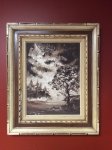


Brian Van Fleet
Pretty Fly for a Bonsai Guy
We have a Before & After thread, and you're all over it. The points of this thread were:Since this seems to be a thread whereby one shows an example of a tree you find masterpiece worthy or inspirational, I find it odd that since the whole point of posting your own work is to see how one treats the material over time and how they have progressed based on their inspiration. So with that, why no before photo's?
1. To see what people here consider to be their epitome of bonsai; because it will be an insightful and wide range.
2. Then, how close are you to achieving what is considered the epitome of bonsai in your garden.
Aim high Al, I believe you can reach your Brussels stock photo!

Grant Hamby
Shohin
I'm thankful for the grey areas. Keeps things interesting.
Anyway, I'm playing again. Single tree this time. Here's a tree from the Winter Silhouette show that, for some strange reason, captivated me more than most. I think I might've been the only one who voted for it, though. Even after I left, I couldn't get this tree out of my head for a while. Can't explain it.

Since I've only been in the game a couple years, I'm still just trying to figure out how that was achieved. Looks like it was a clump reduced to a single trunk. Not sure, but I love the taper. It's almost whimsical. So, to move my trees and my abilities toward something like that, I'm practicing taper techniques. Here's one that I put the hard chop on:

But to stay true to the thread, here's my best maple. I only bought it like 5 months ago, though, so I haven't had much to do with its current state.

Anyway, I'm playing again. Single tree this time. Here's a tree from the Winter Silhouette show that, for some strange reason, captivated me more than most. I think I might've been the only one who voted for it, though. Even after I left, I couldn't get this tree out of my head for a while. Can't explain it.
Since I've only been in the game a couple years, I'm still just trying to figure out how that was achieved. Looks like it was a clump reduced to a single trunk. Not sure, but I love the taper. It's almost whimsical. So, to move my trees and my abilities toward something like that, I'm practicing taper techniques. Here's one that I put the hard chop on:
But to stay true to the thread, here's my best maple. I only bought it like 5 months ago, though, so I haven't had much to do with its current state.
Similar threads


- Replies
- 1
- Views
- 449

- Replies
- 2
- Views
- 1K

